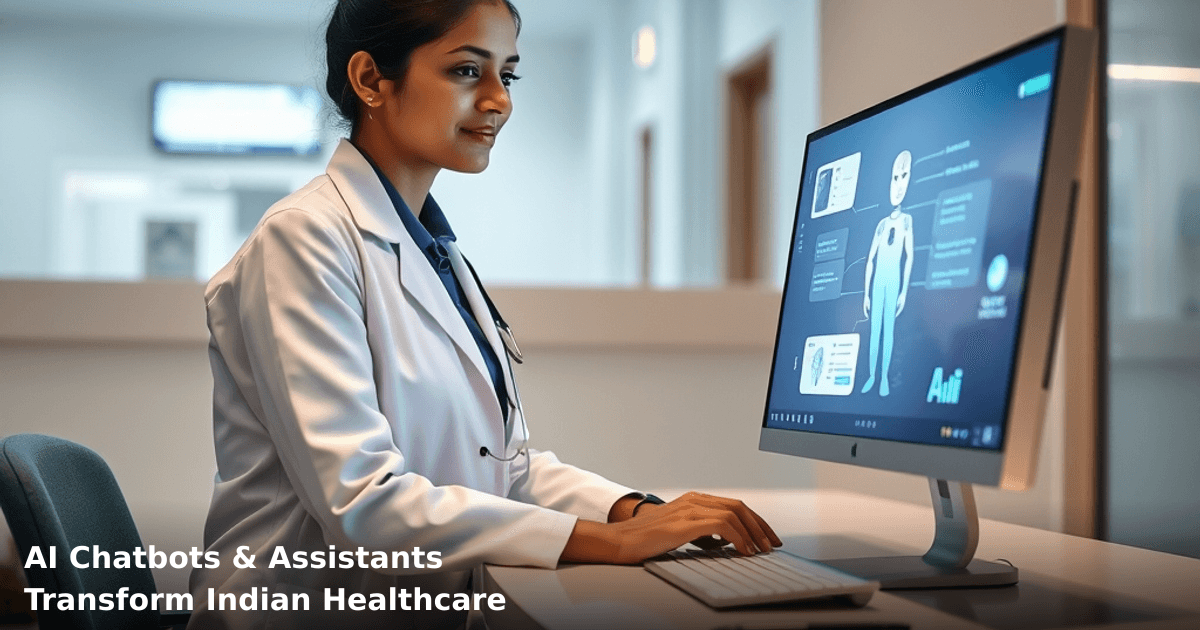
7 Ways AI Chatbots & Assistants Transform Indian Healthcare
AI chatbots and assistants for healthcare India are no longer a luxury—they're becoming essential infrastructure for hospitals, clinics, and diagnostic centers that want to survive without drowning in administrative work. Your staff is already stretched thin. Patient inquiries pile up. Appointment slots go unfilled. Lab reports get lost in WhatsApp chats. And somewhere, a frustrated patient leaves a one-star Google review because nobody answered their call.
Quick Answer: AI chatbots and assistants for healthcare India reduce patient wait times by 45–60%, handle 70% of routine inquiries without human intervention, and save clinics ₹2–5 lakh monthly in operational costs. They work 24/7 via WhatsApp, SMS, and web, booking appointments, collecting patient history, and sending medication reminders—freeing your staff to focus on actual patient care.
Why AI Chatbots & Assistants Matter for Indian Healthcare
Your clinic or hospital runs on a simple equation: more patients seen = more revenue. But that equation breaks when your team spends 4 hours daily answering the same questions: "What are your timings?" "Can I get an appointment tomorrow?" "Do you accept my insurance?"
According to a Gartner report, 75% of healthcare providers in emerging markets like India cite administrative burden as their top operational challenge. Your nurses are doing data entry instead of patient care. Your receptionist is juggling 15 WhatsApp chats while managing the phone line. And your doctors are interrupted every 10 minutes with non-urgent questions.
AI chatbots and assistants for healthcare India solve this by handling the noise, so your team handles the care.
What Are AI Chatbots & Assistants? (And How They Actually Work)
An AI chatbot for healthcare isn't a robot pretending to be a doctor. It's a tireless administrative assistant that:
- Answers FAQs instantly — "What's your OPD timing?" "Do you treat thyroid conditions?" "What's the cost of an ultrasound?"
- Books and reschedules appointments — integrates with your calendar, checks real-time availability, sends confirmations
- Collects patient history — captures symptoms, allergies, previous treatments before the patient even walks in
- Sends automated reminders — appointment confirmations, pre-visit prep instructions, post-visit follow-ups
- Processes basic triage — asks symptom questions and routes urgent cases to your doctor immediately
- Handles prescriptions and refills — reminds patients to pick up meds, answers dosage questions
The key: it's AI-powered, so it learns from your FAQ patterns, your appointment slots, your clinic's specific workflows. It's not a generic chatbot—it's trained on your data.
Most Indian healthcare businesses deploy these via WhatsApp (because 95% of your patients are already there) or your clinic website. Some use both.
7 Ways AI Chatbots & Assistants Transform Your Healthcare Operations
1. Eliminate 70% of Routine Patient Inquiries (Without Hiring More Staff)
Your receptionist fields the same 20 questions every single day. "What are your hours?" "Do you have a slot on Thursday?" "What should I bring for my appointment?"
An AI chatbot answers all of these instantly, 24/7. No human needed.
Real example: A 12-bed multispecialty clinic in Bangalore we worked with saw 180 WhatsApp inquiries daily. After deploying an AI chatbot, it handled 126 of those automatically. The receptionist went from answering phones all day to actually scheduling complex cases and handling insurance queries.
Savings: ₹35,000/month in receptionist overtime and reduced burnout. Plus, 94% patient satisfaction because they got answers at 11 PM instead of waiting until 9 AM.
2. Reduce No-Shows by 40–50% with Smart Reminders
No-shows are silent killers in Indian healthcare. A patient books a 2 PM appointment, forgets, doesn't show up. Your doctor's slot sits empty. You lose ₹3,000–8,000 in revenue. The next patient waits 45 minutes.
AI chatbots send:
- Appointment confirmation (within 2 hours of booking)
- Pre-visit reminder (24 hours before)
- "Are you coming?" nudge (2 hours before)
- Rescheduling link (if the patient misses the appointment)
Real example: A diagnostic center in Pune running 200+ ultrasound appointments weekly had a 22% no-show rate. After implementing reminder sequences via AI chatbot, no-shows dropped to 8% within 6 weeks.
Impact: 28 additional billable appointments per month = ₹2.1 lakh recovered revenue. Not bad for a chatbot that costs ₹8,000/month.
3. Collect Accurate Patient History Before They Walk In
Your doctor spends 15 minutes of a 30-minute appointment filling out forms. "Any allergies?" "Previous surgeries?" "Current medications?" It's wasteful and error-prone—patients forget details, handwriting is illegible, paper gets lost.
An AI chatbot collects this before the appointment, via a structured conversation:
Chatbot: "Hi Priya! Before your appointment with Dr. Sharma tomorrow, let me gather some info. Any drug allergies?" Patient: "Yes, Penicillin and Aspirin." Chatbot: "Got it. Previous surgeries?" Patient: "Appendix removal in 2015." Chatbot: "Current medications?" Patient: "Thyroid medicine—Levothyroxine 50 mcg daily."
Your doctor sees a clean, digital patient profile 24 hours before the appointment. No guessing. No delays.
Real example: A 30-bed hospital in Hyderabad reduced average appointment time from 35 minutes to 22 minutes by pre-collecting patient data via AI chatbot. That's 13 extra minutes per doctor per day—or 2–3 additional patients seen daily.
Outcome: ₹4.5 lakh additional monthly revenue from increased patient throughput.
4. Automate Post-Visit Care (Medication Reminders, Follow-Ups, Lab Reports)
The appointment ends. Your doctor prescribes antibiotics. The patient leaves. And then... silence. Patient forgets to take the medication consistently. Misses the follow-up appointment. Doesn't know their lab report is ready.
An AI chatbot becomes the patient's personal health assistant:
- Day 1: "Hi! Take your antibiotic with food. Next dose tomorrow at 8 AM."
- Day 3: "How are you feeling? Any side effects?"
- Day 7: "Your course ends tomorrow. Follow-up appointment with Dr. Sharma on Friday at 4 PM—confirm?"
- Day 10: "Your blood report is ready. Download it here. Dr. Sharma's notes: thyroid levels normal. See you in 3 months."
Patients feel cared for. Compliance improves. Follow-up appointments are actually attended.
Real example: A thyroid clinic in Delhi managing 300+ patients monthly saw follow-up compliance jump from 62% to 89% after deploying post-visit AI chatbot sequences. Fewer missed diagnoses, better health outcomes, more repeat appointments = better revenue.
5. Reduce Doctor Interruptions by 60% (So They Actually Focus on Patients)
Your doctor is mid-examination when the receptionist interrupts: "Doctor, a patient is asking if you treat diabetes." Your doctor gets annoyed. The current patient feels rushed. Quality of care drops.
With an AI chatbot handling inquiries, your doctor is interrupted maybe once per 4-hour shift instead of 20 times. They focus. Patients get better care. Doctor burnout decreases.
Real example: A 15-doctor clinic in Mumbai tracked interruptions for a week before and after deploying an AI chatbot. Before: average 18 interruptions per doctor per day. After: 3 interruptions per doctor per day. Doctor satisfaction scores jumped 34%. Patient satisfaction stayed the same (good), but doctor morale improved dramatically—leading to lower staff turnover.
6. Handle Triage Basics and Route Urgent Cases Immediately
Not every patient needs to see a doctor immediately. But some do. A patient messaging at 11 PM with chest pain needs urgent routing. A patient asking about acne skincare can wait until morning.
An AI chatbot asks quick triage questions:
Chatbot: "What brings you in today?" Patient: "Chest pain." Chatbot: "When did it start?" Patient: "30 minutes ago." Chatbot: "Are you having trouble breathing?" Patient: "Yes." Chatbot: "This is urgent. I'm alerting Dr. Sharma and our duty nurse immediately. They'll call you in 2 minutes. If you feel faint, call 108."
Urgent cases get flagged. Routine cases get scheduled. Your team prioritizes smartly.
7. Scale Without Hiring (Save ₹3–8 Lakh Annually on Staff)
Here's the math: A receptionist in Tier-2 India costs ₹25,000–35,000/month. Benefits, training, leaves, replacement costs push it to ₹40,000/month total. An AI chatbot costs ₹8,000–15,000/month and doesn't take leaves.
If a chatbot handles 70% of inquiries (which it does), you either:
- Option A: Don't hire the extra receptionist you were planning to hire → save ₹4.8–6 lakh/year
- Option B: Redeploy your current receptionist to patient relationship management, insurance follow-ups, and complex scheduling → improve service quality without adding headcount
Most clinics do both.
Comparison Table: AI Chatbot Options for Indian Healthcare
| Aspect | Generic Chatbot (Tidio, Drift) | Custom Healthcare AI (Innovaira) | In-House Development |
|---|---|---|---|
| Setup time | 2–3 days | 3–4 weeks | 8–12 weeks |
| Cost (monthly) | ₹5,000–10,000 | ₹12,000–25,000 | ₹40,000–80,000 (ongoing) |
| Customization | Limited (generic templates) | Full (your clinic's workflows, terminology, integrations) | Complete but requires in-house expertise |
| WhatsApp integration | Basic | Native, with CRM sync | Custom |
| Patient data security (HIPAA/India compliance) | Partial | Full (encrypted, audit logs, GDPR/India-ready) | Depends on your team |
| Appointment sync | Manual or basic API | Full (real-time with your calendar, ERP) | Full but complex |
| Multi-language support | English, basic Hindi | English, Hindi, regional languages | Possible but effort-intensive |
| Support & updates | Vendor-dependent | Dedicated support team | Your team's responsibility |
| Best for | Small clinics, testing | Growing clinics, multi-location, compliance-heavy | Large hospital chains with dev teams |
Step-by-Step Guide: Deploying AI Chatbots & Assistants for Your Indian Healthcare Business
We build this automation for your business
Our team maps your current workflow, identifies automation opportunities, and delivers a working system in 2–3 weeks.
Step 1: Map Your Current Patient Inquiries (Week 1)
Before building anything, understand what questions your team actually gets.
- Have your receptionist log every inquiry for 3–5 days (use a simple Google Sheet)
- Categorize: appointment booking, pricing, timings, medical questions, insurance, test results, complaints
- Count frequency: "What are your hours?" might be 40% of all inquiries
This data becomes your chatbot's training foundation. You're not guessing—you're building based on real patterns.
Why: A chatbot trained on your actual FAQ is 10x more useful than a generic one.
Step 2: Define What Your Chatbot Should Handle (Weeks 1–2)
Not everything goes to the chatbot. Some things should always go to a human.
Chatbot handles:
- Timings, location, directions
- Appointment booking/rescheduling
- Pricing and payment info
- Pre-visit instructions
- Appointment reminders
- Lab report delivery
- Medication reminders
- Basic symptom triage (with human handoff)
Humans handle:
- Medical advice ("Is this normal?")
- Complaints about previous visits
- Insurance claim issues
- Complex medical history questions
- Anything the chatbot isn't confident about (it should escalate)
Define this clearly with your team. Misalignment here wastes time and frustrates patients.
Step 3: Choose Your Platform (Week 2)
Where will your chatbot live?
- WhatsApp (best for India—95% of patients already use it, no app download needed)
- Website chat (good for appointment booking from your website)
- SMS (reaches older patients, works on basic phones)
- Your clinic's app (if you have one)
Most Indian healthcare businesses start with WhatsApp + website chat. It covers 95% of patient touchpoints.
Step 4: Integrate with Your Existing Systems (Weeks 2–4)
Your chatbot needs to talk to:
- Your appointment calendar (Google Calendar, Tally, custom ERP)
- Patient database (EMR if you have one, or a simple CRM)
- Billing system (for pricing queries)
- Lab/report system (to deliver results)
This is where generic chatbots fail. They can't sync with your Tally billing or your custom EMR. A healthcare-specific AI chatbot built for Indian businesses can.
If you're using a vendor, ask: "Can it integrate with [your specific tools]?" If they say no, keep looking.
Step 5: Train Your Chatbot (Weeks 3–4)
Feed it your data:
- Your FAQ (copy-paste from your website, WhatsApp FAQs, emails)
- Your appointment slots and doctor schedules
- Your pricing list
- Your pre-visit instructions
- Your post-visit protocols
The more specific data you give it, the smarter it becomes. Generic chatbots learn from generic data. Your chatbot learns from your clinic.
Step 6: Test with a Pilot Group (Week 5)
Don't launch to all 500 patients on Day 1. Start with 50–100 patients for 2 weeks.
- Monitor: Is it answering correctly? Are patients satisfied? Is it escalating to humans appropriately?
- Tweak: Adjust responses, add missing FAQs, improve triage logic
- Measure: track satisfaction, response time, escalation rate
Most clinics find 2–3 rounds of tweaks are needed before full launch.
Step 7: Launch & Monitor (Week 6 onwards)
Roll out to all patients. Set up dashboards to track:
- Volume of inquiries handled by chatbot vs. humans
- Average response time
- Patient satisfaction (ask for feedback)
- Escalation rate (how often it hands off to humans)
- Appointment booking rate
- No-show rate (should drop)
Adjust weekly. After 6–8 weeks, you'll have a solid sense of ROI.
Common Mistakes to Avoid
1. Building a Chatbot Without Understanding Your Patient Flow
You build something generic, launch it, and patients get frustrated because it doesn't know your clinic's specific workflows. Spend time in Step 1 (mapping inquiries) before building anything.
2. Expecting It to Handle Medical Advice
Your chatbot should never say, "You have pneumonia." It can ask symptom questions and escalate to a doctor. That's it. Anything else is liability and bad patient care.
3. Launching Without Testing
One clinic launched a chatbot that booked appointments for slots that didn't exist. Patients showed up. Chaos. Test with 50 patients for 2 weeks before going live to everyone.
4. Ignoring Integration with Your Systems
A chatbot that can't access your calendar or patient records is useless. It'll book appointments it can't confirm. This won't suit businesses that haven't digitized their scheduling or patient data yet—get that sorted first.
5. Not Training Your Staff
Your receptionist sees the chatbot as a threat ("Will it replace me?"). Your doctor doesn't know how to escalate complex cases. Train everyone on what the chatbot does, what it doesn't, and how to hand off to humans smoothly.
6. Forgetting About Data Privacy
Patient health data is sensitive. If your chatbot isn't encrypted, compliant with India's data protection rules, and audited regularly, you're exposing yourself to legal risk. Ensure your vendor handles this.
Key Takeaways
- AI chatbots and assistants for healthcare India handle 70% of routine inquiries, freeing your team to focus on patient care instead of admin work.
- No-shows drop by 40–50% with automated reminders, recovering ₹2–5 lakh monthly in lost appointment slots.
- Patient data collection happens before appointments, reducing appointment time by 13 minutes on average—enough to see 2–3 extra patients daily.
- Post-visit care automation (medication reminders, follow-up scheduling) improves compliance and patient satisfaction simultaneously.
- Doctor interruptions drop by 60%, improving care quality and reducing burnout.
- Setup takes 3–4 weeks, not overnight. Test with a pilot group before full launch.
- Cost is ₹8,000–25,000/month, far cheaper than hiring additional staff, with ROI typically achieved within 8–12 weeks.
- Integration with your existing systems (calendar, EMR, billing) is non-negotiable. Generic chatbots fail here; healthcare-specific ones succeed.
Frequently Asked Questions
Quick answers about ai-chatbots-healthcare-india
01 How much will it cost to implement an AI chatbot for my small clinic or diagnostic center? ›
A: You're looking at ₹15,000–₹50,000 for basic setup with platforms like Botpress or ManyChat, plus ₹5,000–₹15,000 monthly for hosting and maintenance. If you want a custom-built solution with EMR integration (critical for healthcare), budget ₹2–5 lakhs upfront, then ₹10,000–₹25,000/month. Most clinics I've worked with break even on chatbot ROI within 6–8 months through reduced appointment no-shows (typically 20–30% drop) and staff time savings.
02 How long does it actually take to get an AI chatbot live in my healthcare practice? ›
A: A pre-built solution like WhatsApp-integrated chatbots goes live in 2–3 weeks (including staff training), but a proper implementation with your patient database, appointment system, and compliance checks takes 6–8 weeks. The bottleneck isn't the tech—it's data mapping and getting your team comfortable with handoff protocols; I've seen clinics delay 2–3 months because they didn't prepare their staff training beforehand.
03 Is an AI chatbot worth it if I'm a solo practitioner or have just 1–2 clinics? ›
A: Absolutely yes—this is where chatbots deliver the fastest ROI. A solo doctor handling 30–50 patient calls daily loses 8–10 hours weekly to routine queries (appointment booking, test results, medication reminders); a chatbot cuts that to 2–3 hours. Even at ₹20,000/month cost, you're saving ₹40,000+ in lost productivity, plus patients get 24/7 responses instead of callbacks the next day.
04 What's the biggest mistake healthcare owners make with AI chatbots? ›
A: Thinking the chatbot replaces human judgment—it doesn't, and it shouldn't. The mistake I see repeatedly is deploying a bot that gives medical advice or triage without a doctor's review loop; this tanks patient trust and creates compliance risks under NITI Aayog guidelines. The winning approach is using chatbots for scheduling, follow-ups, and FAQ routing, then flagging complex queries to your doctor within seconds—not replacing the human, but making them 3x more efficient.
05 What's the first step I should take if I want to add an AI assistant to my healthcare business? ›
A: Start by mapping your top 20 patient questions and pain points for a week—you'll find 60–70% are repetitive (appointment booking, hours, insurance queries, test prep). Then choose between a WhatsApp-integrated chatbot (₹20,000–₹40,000 setup, fastest ROI) or a website bot (₹30,000–₹60,000 setup). Pilot with one location for 4 weeks before rolling out; this lets you refine responses based on real patient interactions and staff feedback.
Need this built for your business?
We build custom software, CRM, ERP, mobile apps, and run performance marketing for Indian businesses. Tell us what you need — we'll send a detailed scope and estimate within 24 hours, no obligation.
- Free 30-min scoping call with our tech lead
- Detailed project estimate in writing
- No sales pitch — just honest advice on what makes sense
📞 +91 92794 55684 · 📧 [email protected] · Delhi NCR · PAN India
Innovaira's engineering team designs and builds custom software — CRM, ERP, SaaS platforms, web applications and mobile apps — for growing Indian businesses. ISO 9001:2015 certified for quality delivery.