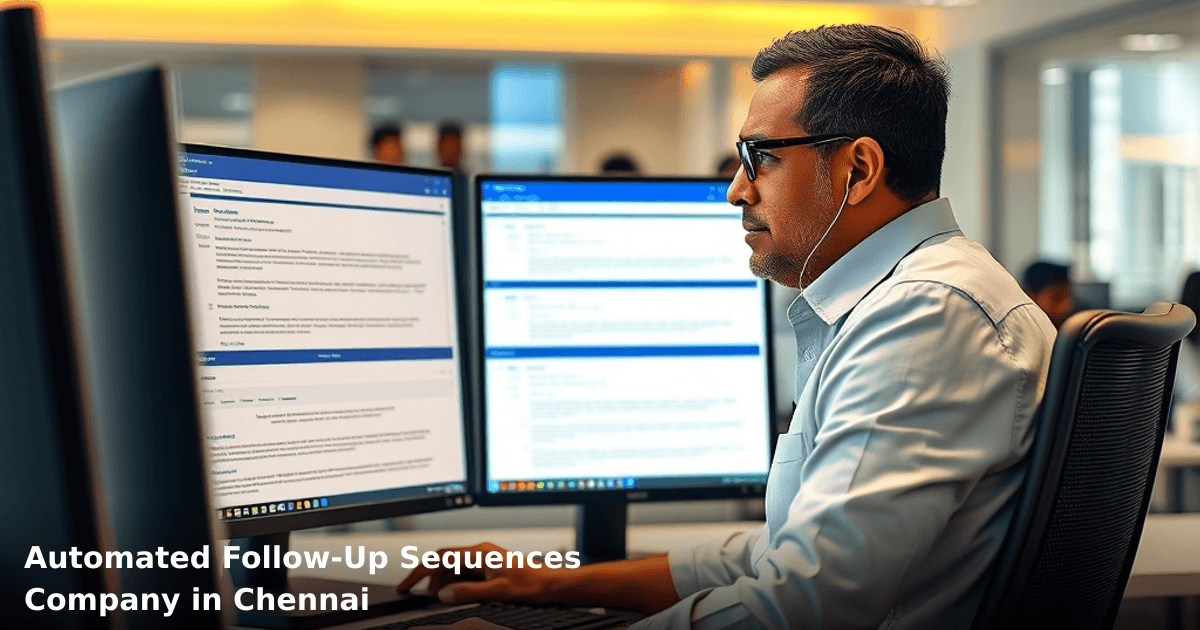
Best Automated Follow-Up Sequences Company in Chennai: How to Choose
You're sitting with 200 leads from your last trade show. Your sales team is drowning. You know that follow-ups are where deals close — but your team is manually sending the same email 15 times a day. That's where automated follow-up sequences in Chennai, India can save your business months of wasted effort.
Quick Answer: Automated follow-up sequences are pre-built workflows that send targeted messages (email, SMS, WhatsApp) to prospects at the right time without manual intervention. For Chennai-based businesses, the right automation company can reduce follow-up time by 70–80% and increase conversion rates by 25–40% within the first 90 days. Costs typically range from ₹5,000 to ₹25,000/month depending on volume and complexity.
Why Automated Follow-Up Sequences Matter for Indian Businesses
The Chennai SMB Reality
Chennai's manufacturing, textile, IT services, and logistics sectors are booming. But here's what we see repeatedly: businesses with solid leads and weak follow-ups. A McKinsey report noted that 65% of Indian SMBs lose deals not because of bad products, but because they don't follow up consistently.
When you're managing 5–50 salespeople, manual follow-ups become chaos. Your team forgets which lead got which email. Timing slips. Prospects go cold. Your competitor — the one using automated follow-up sequences — sends the right message at the right time and closes the deal.
The Numbers That Matter
- 67% of lost sales happen because follow-ups stop after the first contact.
- Statista data shows businesses that automate follow-ups see 30% faster sales cycles.
- Economic Times report highlighted that Indian SMBs using CRM with automation reduced sales admin time by 15–20 hours/week.
- A textile exporter in Coimbatore we worked with went from 3-day follow-up delays to same-day automated sequences — their close rate jumped from 18% to 31% in 6 months.
What Are Automated Follow-Up Sequences? How They Work
Automated follow-up sequences are workflows that trigger messages based on prospect behavior or time intervals. Think of it as a very organized assistant who never forgets, never sleeps, and never gets frustrated.
The Flow
- Prospect lands in your system — via contact form, WhatsApp, or CRM import
- Sequence starts automatically — first email/SMS/WhatsApp goes out immediately or at a scheduled time
- Behavior triggers next steps — if they open the email, send message #2; if they click a link, send a different message
- Delays between touchpoints — typically 1–3 days between messages (you set this)
- Sequence ends or branches — when they convert, go silent, or move to sales
- Data is logged — you see who opened, clicked, replied, or ignored
For Chennai businesses, this means your textile supplier can send 500 follow-ups while you're in a meeting. Your IT services firm can nurture 50 prospects simultaneously. Your logistics startup can keep leads warm for months without hiring extra staff.
Automated Follow-Up Sequences vs. Manual Follow-Ups: Quick Comparison
| Aspect | Manual Follow-Ups | Automated Follow-Up Sequences |
|---|---|---|
| Time per 100 leads | 8–12 hours/week | 30 minutes setup; runs on its own |
| Consistency | Depends on team mood/workload | 100% consistent, every time |
| Cost (monthly) | ₹40,000–₹80,000 (2 staff + overhead) | ₹5,000–₹25,000 (depending on platform) |
| Personalization | Limited (copy-paste) | High (dynamic fields, behavioral triggers) |
| Response time | 2–5 days average | Immediate or scheduled precisely |
| Conversion rate | 8–12% | 18–35% (with proper setup) |
| Scalability | Breaks at 50+ leads/week | Handles 1,000+ leads/week easily |
| Data accuracy | Manual errors common | Automatic logging, no gaps |
Why You Need a Specialized Company (Not Just Software)
We build this automation for your business
Our team maps your current workflow, identifies automation opportunities, and delivers a working system in 2–3 weeks.
Here's what we tell clients: buying software ≠ having a system.
You can buy Mailchimp or Pipedrive tomorrow for ₹2,000/month. But:
- Your CRM data is messy (duplicate contacts, wrong email formats, missing phone numbers)
- You don't know which sequences actually work for your industry
- You have no idea what message timing converts best for your customers
- Your team doesn't know how to use it, so it sits idle
- Integration with WhatsApp, SMS, and your existing tools becomes a headache
A good automated follow-up sequences company in Chennai (or serving Chennai) handles all of this. They:
- Audit your current process — what's working, what's not
- Design sequences for your industry — a luxury real estate agent's follow-up looks nothing like a B2B SaaS company's
- Set up integrations — CRM, email, WhatsApp Business API, SMS providers, payment gateways
- Train your team — so they actually use it
- Test and optimize — A/B test subject lines, timing, and messaging to find what converts
- Monitor and report — monthly dashboards showing ROI
Step-by-Step Guide to Choosing the Right Automated Follow-Up Sequences Company in Chennai
1. Confirm They Understand Your Industry
Ask the company: "Tell me three follow-up sequences you've built for [your industry]."
If they blank, move on. A company serving textile exporters in Tiruppur should know that B2B buyers respond differently to follow-ups than B2C. A logistics startup needs sequences that handle long sales cycles (60–90 days). A dental clinic needs reminders and appointment confirmations, not discount codes.
We've worked with companies claiming they're "experts in all industries" — they're experts in none. Look for specific case studies from your sector.
2. Check Their Integration Capabilities
Your CRM is probably Zoho, Salesforce, or a custom system. Your email is Gmail or Outlook. You might use WhatsApp for customer contact.
Ask:
- "Can you sync with our CRM automatically?"
- "Do you handle WhatsApp Business API integration?"
- "Can you pull data from Tally or our custom database?"
- "How do you handle SMS routing?" (Most Indian businesses need this.)
If they say "we can do anything," ask for a technical spec. Real companies give you documentation. Vague companies give you promises.
3. Look at Their Reporting and Analytics
You need to see:
- Open rates — how many people opened your email/WhatsApp
- Click-through rates — how many clicked your link
- Conversion rates — how many became customers
- Cost per conversion — ROI of the whole thing
- Sequence performance — which messages work, which don't
Ask to see a sample dashboard. If they show you vanity metrics (total emails sent, total contacts), that's not useful. You want actionable data.
4. Verify Their WhatsApp and SMS Compliance
This is India-specific and non-negotiable.
- WhatsApp Business API — they should be a registered WhatsApp Business Solution Provider
- SMS compliance — they should understand DND (Do Not Disturb) rules and TRAI guidelines
- Consent management — they track who opted in and who didn't
- Template approval — they know the process for getting WhatsApp message templates approved
We've seen companies send unsolicited WhatsApp messages and get their business accounts banned. Don't be that company.
5. Ask About Onboarding and Support
A ₹15,000/month tool is useless if you can't use it.
- How long is onboarding? (Should be 2–4 weeks, not 2 months)
- Do you clean and audit our existing data? (This takes time but it's critical)
- What's included in support? (Email? Phone? Dedicated account manager?)
- Do you offer training for my team? (Not just video tutorials — actual hands-on training)
- Can you help us optimize sequences after launch? (This is where real value comes)
If they say "we'll set it up and you're on your own," that's a red flag. Automation requires ongoing tweaking.
6. Compare Pricing and Contract Terms
Pricing for automated follow-up sequences in Chennai typically ranges:
- Basic tier — ₹5,000–₹8,000/month (up to 500 contacts, limited sequences)
- Mid-tier — ₹12,000–₹18,000/month (up to 2,000 contacts, advanced features, WhatsApp integration)
- Premium tier — ₹20,000–₹35,000/month (unlimited contacts, custom workflows, dedicated support)
Watch out for:
- Hidden setup fees — some charge ₹10,000–₹50,000 upfront
- Per-contact overage charges — if you grow beyond your tier, they charge extra per contact
- Minimum contract lock-in — 12-month contracts are common; negotiate for 3–6 months if possible
- Cancellation penalties — read the fine print
Common Mistakes to Avoid When Setting Up Automated Follow-Up Sequences
1. Too Many Sequences, No Segmentation
We see companies blast the same 5-email sequence to everyone — cold leads, warm leads, past customers. That's spam, not automation.
Fix: Segment your list. Different sequences for different stages:
- Cold leads → longer nurture sequence (8–10 emails over 60 days)
- Warm leads (they've shown interest) → shorter, more aggressive sequence (3–5 emails over 14 days)
- Past customers → loyalty and upsell sequences
2. Ignoring Timing
Sending an email at 2 AM because "the system was set up" is wasteful. Your Chennai IT buyer isn't checking email at midnight.
Fix: Test timing. For most Indian B2B businesses, 9–11 AM and 3–5 PM work best. For B2C, 6–8 PM often converts better. Track open rates by time and adjust.
3. Generic, Bland Messaging
"Hi [First Name], we have a great product for you" — this gets deleted in 0.5 seconds.
Fix: Personalize beyond the name. Reference their company, their role, a recent action they took. "Hi Rajesh, saw you downloaded our textile automation guide — here's how Coimbatore exporters are cutting production time by 30%."
4. No Clear Call-to-Action
Each message should have ONE clear next step. "Schedule a demo," "Reply with your timeline," "Click here for a free audit." Not five CTAs. One.
5. Fire and Forget
You set up sequences and assume they're working. Six months later, your open rates have dropped 40%, but you didn't notice.
Fix: Monthly reviews. Check open rates, click rates, unsubscribe rates. If open rate drops below 15%, change your subject lines. If click rate is below 3%, change your CTA or offer.
Key Takeaways
- Automated follow-up sequences reduce follow-up time by 70–80% and increase conversion rates by 25–40% for Chennai-based businesses.
- Manual follow-ups cost ₹40,000–₹80,000/month in staff time; automation costs ₹5,000–₹25,000/month and is infinitely more scalable.
- Choose a company that knows your industry — textile, logistics, IT services, real estate, or healthcare. One-size-fits-all doesn't work.
- Integration is non-negotiable — your CRM, WhatsApp, SMS, and email must sync automatically. If they can't do this, they can't deliver ROI.
- WhatsApp and SMS compliance is India-specific — make sure they're WhatsApp Business API certified and follow TRAI DND rules.
- Onboarding and support matter more than the software itself. A ₹15,000/month tool with great support beats a ₹5,000 tool with none.
- Segment your lists and personalize your sequences. Different prospects need different messages at different times.
Frequently Asked Questions
Quick answers about automated-follow-up-sequences-chennai-india
01 How much does an automated follow-up sequence tool actually cost for a small business in Chennai? ›
Most Chennai-based SMBs pay ₹2,000–₹8,000 per month for basic follow-up automation (50–500 contacts), while mid-market solutions run ₹15,000–₹40,000 monthly with advanced segmentation and CRM integration. The key is that you're not paying for the software alone—you're paying for the time saved; a typical sales team wastes 25–30% of their day on manual follow-ups, which translates to ₹1.5–₹2 lakhs in lost productivity annually for a 5-person team.
02 How long does it take to see results after setting up an automated follow-up sequence? ›
You'll see initial traction within 7–10 days (higher email open rates and response times), but measurable revenue impact typically appears in 4–6 weeks once your sequences are refined based on actual customer behavior data. Most Chennai businesses report a 15–25% improvement in conversion rates by week 8, though this depends heavily on whether your sequences are personalized or generic templates.
03 Is automated follow-up software worth it if I'm a solo entrepreneur or have just 2–3 salespeople? ›
Absolutely—in fact, it's more critical for you than for larger teams because your time is your biggest constraint; even a solo founder can manage 100+ leads simultaneously with automation, turning what would take 15 hours weekly into 2–3 hours of strategy and optimization. I've seen solo consultants in Chennai increase their close rate from 8% to 18% within 90 days just by implementing structured follow-up sequences instead of sporadic emails.
04 What's the biggest mistake SMB owners make when choosing a follow-up automation company? ›
The most common trap is picking a tool based on features rather than ease of integration with your existing systems—I've seen businesses waste ₹50,000+ implementing software that doesn't connect with their WhatsApp, email, or accounting system, forcing manual data entry anyway. Always ask the vendor: "Does this integrate with [your CRM/email/payment tool]?" and request a 2-week trial with your actual data before committing.
05 What's the first step I should take if I've decided to implement follow-up automation in my Chennai business? ›
Start by auditing your current sales pipeline—identify where leads drop off (typically 40–60% abandon after the first touchpoint in most SMBs) and map out your ideal follow-up sequence on paper before touching any software. Then choose a vendor that offers onboarding support (₹5,000–₹15,000 one-time setup fee is worth it), because 60% of Chennai SMBs fail at automation simply due to poor initial configuration, not tool limitations.
Need this built for your business?
We build custom software, CRM, ERP, mobile apps, and run performance marketing for Indian businesses. Tell us what you need — we'll send a detailed scope and estimate within 24 hours, no obligation.
- Free 30-min scoping call with our tech lead
- Detailed project estimate in writing
- No sales pitch — just honest advice on what makes sense
📞 +91 92794 55684 · 📧 [email protected] · Delhi NCR · PAN India
Innovaira's engineering team designs and builds custom software — CRM, ERP, SaaS platforms, web applications and mobile apps — for growing Indian businesses. ISO 9001:2015 certified for quality delivery.