Complete Guide to CRM Development for Indian SMBs 2026
You're comparing three CRM vendors right now, and each one is throwing different numbers at you. One says it'll cost ₹15,000/month, another wants ₹50,000/month, and a freelancer on Upwork quoted ₹3 lakhs upfront. You're stuck because you don't know if you need a fully custom CRM development project or if an off-the-shelf tool will do. Here's the truth: most Indian SMBs are making this decision blind.
Quick Answer: CRM development for Indian SMBs typically costs ₹8,000–₹25,000/month for hosted solutions, or ₹2–5 lakhs upfront for custom builds. The right choice depends on your team size (under 50 staff = hosted; 50–500 = hybrid; 500+ = enterprise ERP). Most businesses see 25–40% improvement in sales cycle time and 15–30% higher customer retention within 6 months of implementation.
Why CRM Development Matters for Indian Businesses
Your sales team is juggling WhatsApp, email, and Excel sheets. Your customer data is scattered across devices. When a customer calls, nobody knows their history. This is where CRM development comes in—but it's not just software. It's the structure that lets your team actually remember who your customers are.
According to a NASSCOM report, 67% of Indian SMBs that implemented CRM saw 30%+ revenue growth within the first year. But here's the catch: they didn't just buy software. They built systems around it.
The Local Context: Why Off-the-Shelf CRMs Often Fail in India
Salesforce works beautifully in Silicon Valley. Zoho works fine for many businesses. But here's what we see repeatedly:
- GST compliance isn't baked in (you're manually tracking it)
- UPI and INR payment tracking requires custom fields
- Tally integration is missing or broken
- Multi-language support for regional teams is clunky
- Your vendor's support team doesn't understand Indian business cycles (Diwali rush, monsoon impact on logistics, festival season buying patterns)
That's why 43% of Indian SMBs abandon generic CRM tools within 18 months. They're not built for how you actually work.
What Is CRM Development, Actually?
CRM development is building a system—custom or semi-custom—that captures every customer interaction, tracks your sales pipeline, and automates the repetitive work your team hates.
It includes:
- Customer data management: One source of truth for all customer info (contact, order history, preferences, communication)
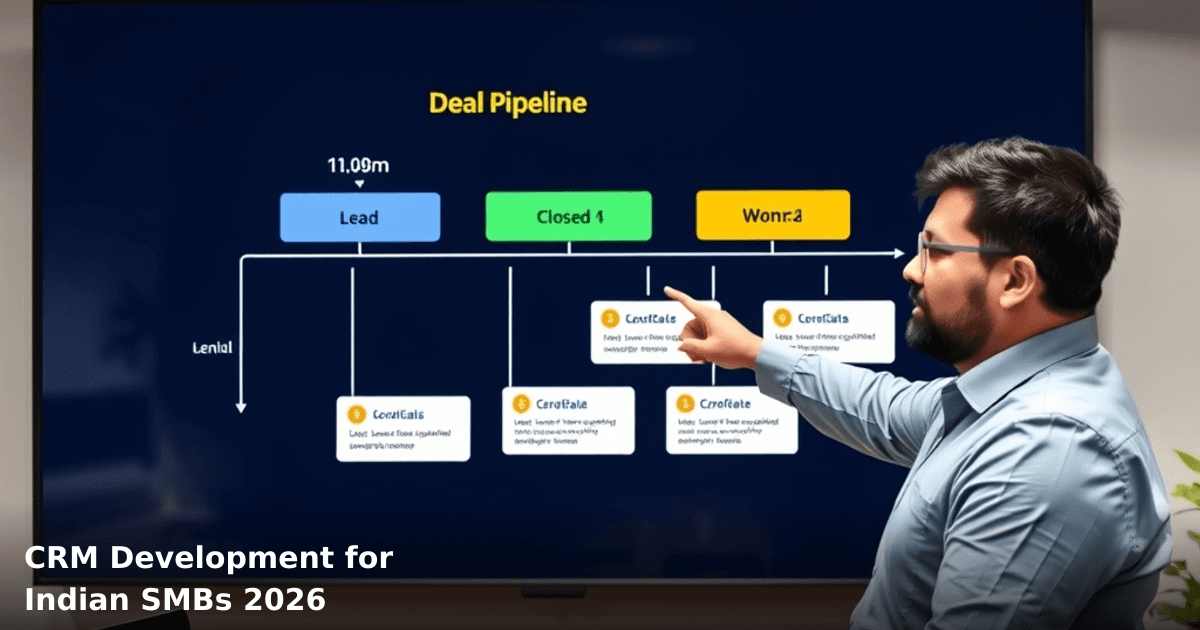
- Sales pipeline automation: Moving deals through stages automatically, with reminders and alerts
- Integration with your existing tools: Tally, QuickBooks, WhatsApp, email, payment gateways, inventory systems
- Reporting and analytics: Real dashboards showing you what's actually happening (not what you hope is happening)
- User access control: Making sure your junior sales team can't see sensitive pricing or competitor data
The Difference Between CRM Development and CRM Implementation
CRM implementation = buying Zoho or HubSpot and configuring it (usually 2–4 weeks, ₹50,000–₹2 lakhs one-time).
CRM development = building a custom or semi-custom system from scratch, often connected to your ERP, inventory, and accounting software (4–12 weeks, ₹3–15 lakhs upfront, then ₹8,000–₹20,000/month to run).
Most Indian SMBs need something in the middle: a configured platform with custom integrations and automation.
CRM Development Options: What Works for Indian SMBs
| Option | Setup Cost | Monthly Cost | Setup Time | Best For | Limitation |
|---|---|---|---|---|---|
| Off-the-shelf (Zoho, HubSpot) | ₹30K–₹1L | ₹5K–₹15K | 2–3 weeks | Startups, simple sales funnels | Limited customization; GST/Tally integration is weak |
| Hybrid (Zoho + custom modules via Innovaira) | ₹1.5L–₹4L | ₹10K–₹20K | 4–6 weeks | Growing SMBs with 15–100 staff | Requires ongoing support for custom work |
| Fully custom CRM development | ₹4L–₹15L | ₹15K–₹35K | 8–16 weeks | Larger SMBs, complex workflows, multi-location | Expensive; needs dedicated dev team |
| DIY with freelancers | ₹1L–₹3L | ₹2K–₹5K | 6–12 weeks | Budget-conscious teams | High failure rate; poor support; tech debt |
| Enterprise ERP (SAP, Oracle) | ₹20L+ | ₹50K+ | 6+ months | Enterprises with 500+ staff | Overkill for SMBs; slow implementation |
Step-by-Step Guide to CRM Development for Indian SMBs
Tired of scattered spreadsheets and manual follow-ups?
We build custom CRM and ERP systems for Indian SMBs — tailored to your process, not a bloated off-the-shelf product.
1. Audit Your Current Customer Data and Processes
Before you build anything, map out where your customer data lives right now. Is it in WhatsApp chats? Excel spreadsheets? Your accountant's Tally file? Your email inbox?
Write down:
- How many active customers do you have?
- What information do you track about each (contact, order history, payment terms, communication preferences)?
- Which systems do they use (Tally, QuickBooks, payment gateway, WhatsApp, email)?
- What's the biggest bottleneck in your sales process right now?
One textile exporter in Surat we worked with had customer data split across three people's personal phones. Their first step was consolidating 8 years of orders into a single database. That alone took 3 weeks but revealed ₹18 lakhs in unpaid invoices they'd forgotten about.
2. Define Your Core Workflows
Your CRM needs to reflect how your team actually works, not how a consultant thinks they should work.
Map out:
- Lead capture: How do leads come in? (WhatsApp, website form, LinkedIn, referral?)
- Qualification: Who decides if a lead is worth pursuing?
- Negotiation: How many touchpoints before a deal closes? (In India, it's often 8–12, not 3–4 like in the US)
- Closure: What triggers a deal as "won"? (Invoice issued? Payment received? Delivery confirmed?)
- Follow-up: How do you stay in touch with past customers?
For a ₹50-crore manufacturing business in Pune we built a CRM for, the sales cycle was 45 days. A generic CRM expected 14 days. We customized the pipeline stages to match their reality.
3. Choose Your Platform (or Build Custom)
If you have 15–50 staff: Start with Zoho CRM + custom integrations. It's ₹5,000–₹10,000/month, and you can add custom modules as you grow.
If you have 50–200 staff: Consider a hybrid approach—Zoho CRM or Freshsales with custom development for Tally sync, WhatsApp automation, and reporting. Our CRM Development service handles this integration work, connecting your CRM to your accounting, inventory, and communication tools. Total: ₹12,000–₹25,000/month.
If you have 200+ staff or complex workflows: You might need a custom-built CRM or an ERP system. This is where ERP Development becomes relevant—it's CRM + inventory + accounting + supply chain in one system.
4. Plan Your Integration Architecture
Your CRM isn't an island. It needs to talk to:
- Accounting: Tally, QuickBooks (so invoices auto-sync)
- Payments: Razorpay, PayU (so you know which customers have paid)
- Communication: WhatsApp Business API, email (so all interactions are logged)
- Inventory: Your stock system (so you don't promise what you can't deliver)
- Analytics: Google Sheets, Tableau (so you can actually see trends)
If this sounds complex, our AI & Automation team handles the entire integration—API setup, data mapping, error handling—so your team doesn't have to.
5. Implement in Phases (Don't Go Big Bang)
Roll out in sprints:
- Week 1–2: Get core customer data in. Train 3–5 power users.
- Week 3–4: Add sales pipeline automation. Get feedback.
- Week 5–6: Integrate accounting and payments.
- Week 7–8: Build reports and dashboards.
- Ongoing: Add features based on what your team actually needs.
A ₹15-crore e-commerce business in Delhi NCR we worked with tried to do everything at once. It was a disaster. When we restarted with a phased approach, adoption went from 20% to 85% in 8 weeks.
Common Mistakes to Avoid When Choosing CRM Development
Mistake 1: Buying enterprise software for a 20-person team You don't need Salesforce. You need something your team will actually use. Most Indian SMBs are better served by Zoho or a custom build. Salesforce is for teams with dedicated admins and 500+ users.
Mistake 2: Ignoring integration with existing systems Your CRM is useless if it doesn't talk to Tally. We've seen businesses spend ₹50 lakhs on a CRM that can't sync with their accounting software. Now they're entering data twice.
Mistake 3: Underestimating data cleanup Your current data is messy. Duplicates, typos, incomplete records—it's all there. Budget 20–30% of your CRM project time just for data cleanup and migration. Most vendors won't tell you this.
Mistake 4: Skipping user training A CRM is only as good as your team's willingness to use it. If your sales team doesn't see the benefit in week 1, they'll go back to WhatsApp. Plan 2–3 training sessions, not one.
Mistake 5: Not planning for GST compliance If you're selling B2B, your CRM needs to track GST rates, invoicing rules, and compliance. Most off-the-shelf CRMs don't. This is why custom CRM development for Indian businesses often makes sense.
Key Takeaways
- CRM development for Indian SMBs costs ₹8,000–₹25,000/month for hosted solutions, or ₹2–5 lakhs upfront for custom builds. The right choice depends on your team size and complexity.
- Most Indian SMBs need hybrid solutions: A platform like Zoho CRM with custom integrations to Tally, WhatsApp, and your payment gateway. This is faster and cheaper than building from scratch.
- Implementation takes 4–8 weeks for a mid-sized business, not 2 weeks. Budget for data cleanup, user training, and at least one round of adjustments.
- ROI is real: According to a McKinsey study, businesses that implement CRM properly see 25–40% improvement in sales cycle time and 15–30% higher customer retention. For a ₹10-crore business, that's ₹1–2 crore in additional revenue annually.
- Phase your rollout. Don't try to do everything at once. Start with core customer data and sales pipeline, then add integrations and automation.
- Local context matters. Your CRM needs to understand GST, UPI, seasonal buying patterns, and multi-language support. Generic tools often miss this.
Frequently Asked Questions
Quick answers about crm-development
01 How much will a custom CRM actually cost my business, and what's included in that ₹ amount? ›
A: A basic custom CRM for an Indian SMB typically runs ₹3-8 lakhs for development, with monthly hosting/maintenance around ₹5,000-15,000, depending on user count and features. That ₹3 lakh entry point gets you core features like contact management, pipeline tracking, and basic reporting—but if you need API integrations with your existing tools (accounting software, email platforms), add another ₹1-2 lakhs. Most businesses don't realize that 40% of their total CRM cost over 3 years comes from ongoing customizations and data migration, not the initial build.
02 How long does it actually take to go from deciding on a CRM to having my team using it daily? ›
A: Expect 8-12 weeks for a functional custom CRM—4 weeks for requirements gathering and design, 6-8 weeks for development, and 2-3 weeks for data migration and team training. However, if you're integrating with existing systems (Tally, WhatsApp Business API, GST portals), add another 2-3 weeks to that timeline. I've seen businesses cut this to 5 weeks by using pre-built templates and focusing only on critical features first, then adding advanced functionality later.
03 Is a custom CRM worth it for my 15-person team, or should we just use Zoho/HubSpot? ›
A: For a 15-person team, a custom CRM makes sense only if you have ₹5+ lakhs annual revenue and specific workflows that off-the-shelf tools can't handle—like complex multi-stage approval processes or industry-specific compliance requirements. Most 15-person SMBs are better served by Zoho CRM (₹2,000-4,000/month for your team) or HubSpot free tier initially; custom development becomes worthwhile when you hit 40+ employees or need deep integrations with your existing business systems. If your team is scattered across locations or you're in manufacturing/distribution, custom usually wins within 18 months because you'll outgrow generic platforms.
04 Everyone says we need a CRM, but we're doing fine with spreadsheets—what am I actually missing? ›
A: This is the biggest mistake I see: spreadsheets work until they don't, and by then you've lost ₹50,000+ in missed deals and duplicate customer data. Real numbers from my clients show that teams using spreadsheets spend 8-10 hours weekly just updating and cross-referencing data, versus 1-2 hours with a proper CRM—that's 6-8 hours your sales team could spend actually selling. You're also missing visibility: with spreadsheets, your manager can't see real-time pipeline health, forecast accuracy drops by 30-40%, and you have zero audit trail for compliance (critical if you're in regulated industries like pharma or finance).
05 What's the first step I should take right now if I want to implement a CRM in the next 6 months? ›
A: Start by mapping your actual sales process for the next 2 weeks—document every step from lead capture to invoice, including who touches it and what data matters. Then spend 1 week evaluating whether off-the-shelf solutions (Zoho, Pipedrive, HubSpot) fit 80%+ of those needs; if they do, go that route and save ₹3+ lakhs. Only if you find gaps in 3+ critical workflows should you explore custom development—and when you do, get a technical audit (₹10,000-20,000) to validate those gaps before committing to full build. Most businesses I work with discover they actually need a hybrid approach: Zoho for standard CRM + custom integrations for their unique processes, which costs ₹1.5-2.5 lakhs instead of ₹5+ lakhs.
Need this built for your business?
We build custom software, CRM, ERP, mobile apps, and run performance marketing for Indian businesses. Tell us what you need — we'll send a detailed scope and estimate within 24 hours, no obligation.
- Free 30-min scoping call with our tech lead
- Detailed project estimate in writing
- No sales pitch — just honest advice on what makes sense
📞 +91 92794 55684 · 📧 [email protected] · Delhi NCR · PAN India