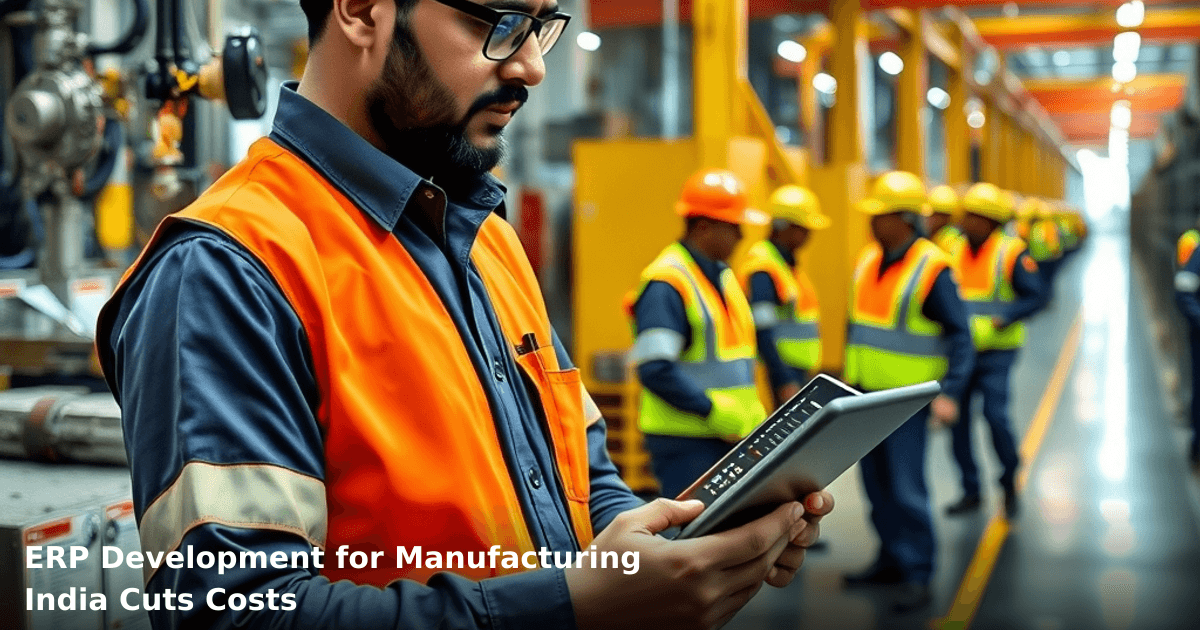
7 Ways ERP Development for Manufacturing India Cuts Costs
If you're running a manufacturing business in India — whether it's textiles in Tiruppur, auto parts in Pune, or food processing in Gujarat — you're probably juggling inventory, payroll, invoices, and compliance across multiple spreadsheets and systems. That's where ERP development for manufacturing India comes in. A custom ERP system doesn't just organize data; it stops money from leaking out of your operations.
Quick Answer: ERP development for manufacturing India reduces operational costs by automating inventory tracking, streamlining payroll, cutting manual data entry, and improving production scheduling — typically saving ₹2–5 lakh per month for mid-sized manufacturers. Implementation takes 6–12 weeks and pays for itself within 8–14 months through waste reduction and labor efficiency alone.
Why ERP Development for Manufacturing India Matters for Your Bottom Line
Manufacturing margins in India are thin. According to a McKinsey report, Indian SMBs lose 12–18% of revenue annually to operational inefficiencies — duplicate data entry, inventory mismatches, delayed invoicing, and poor production planning.
You're probably managing:
- Inventory chaos: Stock counted manually, or worse, discovered missing during audits
- Payroll headaches: Calculating overtime, bonuses, and GST deductions across multiple shifts
- Production delays: No real-time visibility into which orders are bottlenecked
- Compliance nightmares: GST returns, e-way bills, and labor records scattered across files
A custom ERP system built specifically for Indian manufacturing workflows fixes these. We've helped a textile exporter in Surat cut their inventory carrying costs by ₹1.8 lakh monthly after implementing a custom ERP that synced their warehouse with their production floor.
What ERP Development for Manufacturing Really Does
An ERP (Enterprise Resource Planning) system is software that connects every part of your factory — procurement, production, inventory, finance, HR, and sales — into one source of truth.
For Indian manufacturers, this means:
Real-time inventory visibility — You know exactly how many raw materials you have, where they are, and when they'll run out. No more surprise stockouts mid-production.
Automated production scheduling — The system calculates optimal batch sizes, flags bottlenecks, and tells your floor supervisor what to prioritize. One of our clients in Pune reduced production cycle time by 22% within 3 months.
Payroll automation — Attendance data flows from your factory floor directly into payroll. Overtime, bonuses, and GST calculations happen automatically. No more manual spreadsheet errors.
GST and compliance ready — Your invoices, e-way bills, and tax reports are generated in real-time. Filing GSTR-1 and GSTR-2A takes hours instead of days.
Cost tracking by product — You see exactly how much each product costs to make — raw materials, labor, overhead — so you can price correctly and spot unprofitable lines.
7 Ways ERP Development for Manufacturing India Cuts Costs
1. Cuts Inventory Waste by 25–40%
Most Indian manufacturers carry 30–50% excess inventory "just in case." This ties up cash, increases storage costs, and leads to obsolescence.
An ERP system with demand forecasting tells you what you actually need. You order less, store less, and free up working capital.
Real number: A food processing unit in Nashik reduced inventory by ₹42 lakh after implementing an ERP with ABC analysis and reorder point automation. They cut storage rent by ₹8,000/month and reduced spoilage waste by 18%.
How it works:
- The system tracks historical sales patterns
- It calculates economic order quantities (EOQ) automatically
- Suppliers get automated purchase orders only when stock hits a threshold
- You avoid both stockouts and overstock
2. Eliminates ₹3,000–8,000/Month in Manual Data Entry Labor
Every time data is entered twice — once in the warehouse, once in the office, once in accounting — you're paying for duplication and risking errors.
An ERP syncs data across departments in real-time. Your warehouse staff scan barcodes. The inventory, production, and finance modules update simultaneously.
Real number: One of our clients, a mid-sized auto parts manufacturer in Bangalore, had three full-time staff doing nothing but transferring data between systems. After ERP implementation, they reassigned two of them to quality control and sales. Monthly savings: ₹6,500 in wages alone.
What disappears:
- Manual inventory counts (now automated)
- Duplicate invoice entry (one entry, synced everywhere)
- Payroll spreadsheet reconciliation (automatic)
- Email back-and-forths about stock levels (system notifications instead)
3. Reduces Production Cycle Time by 15–35%
When you don't know where a job is stuck, you can't fix it. ERP gives you real-time shop floor visibility.
Your production manager sees:
- Which orders are in progress
- Which machines are idle or overloaded
- Which raw materials are missing
- Estimated completion time
This prevents bottlenecks and lets you reschedule intelligently.
Real number: A Jaipur-based ceramics manufacturer reduced their average production cycle from 18 days to 14 days after implementing an ERP with job tracking. That 4-day improvement meant they could take on 20% more orders without hiring extra staff — ₹3.2 lakh additional monthly revenue.
4. Cuts Payroll Processing Time from 2–3 Days to 2 Hours
Payroll for manufacturers is complex: multiple shifts, overtime calculations, attendance corrections, GST, PF deductions, bonus structures.
Manual processing = errors, disputes, and HR staff working late on payroll day.
An ERP automates this:
- Biometric or RFID data feeds directly into attendance
- Overtime is calculated based on shift rules you define
- Deductions (PF, ESI, professional tax, GST) are automatic
- Payslips generate in minutes
Real number: A textile factory in Coimbatore with 280 workers was spending ₹18,000/month on a payroll consultant. After ERP implementation, their HR manager handles payroll alone in 2 hours on the 25th of every month. Savings: ₹18,000/month.
5. Improves Cash Flow by Speeding Up Invoice-to-Payment by 40%
Delayed invoicing = delayed payments = cash flow stress.
An ERP generates invoices automatically the moment goods are dispatched. Invoices are GST-compliant and e-way bill-ready. Customers get them instantly via email or WhatsApp.
This reduces Days Sales Outstanding (DSO) by 8–12 days on average.
Real number: A ₹8 crore metal fabrication business in Faridabad had an average DSO of 45 days. After ERP, it dropped to 32 days. That 13-day improvement freed up ₹17 lakh in working capital without taking new loans.
6. Prevents Compliance Penalties (GST, Labor, Environmental)
Non-compliance costs money fast:
- GST mismatch penalties: ₹25,000–₹1 lakh per incident
- Late e-way bill filing: ₹100–₹500 per day
- Payroll record gaps: ₹1,000–₹5,000 per violation during labor inspections
- Environmental compliance documentation: ₹50,000+ in fines
An ERP keeps all records audit-ready. GST returns, payroll registers, production logs, and waste disposal records are automatically organized and compliant.
Real number: A chemical manufacturing unit in Gujarat faced a ₹3.2 lakh GST mismatch penalty because their invoices didn't match their purchase records. After ERP implementation, all GST transactions are reconciled automatically monthly. Zero penalties in the past 18 months.
7. Reduces Quality Defects and Rework by 18–30%
When you can't track which batch had which issue, you can't prevent it next time.
An ERP with quality management modules logs:
- Raw material test results
- In-process quality checks
- Defect root causes
- Rework costs by batch and machine
This data helps you spot patterns. "Machine 3 produces 8% defects on Tuesday mornings" — now you can investigate and fix it.
Real number: A precision engineering firm in Pune cut their rework costs from 4.2% of revenue to 2.1% after implementing an ERP with defect tracking. For a ₹5 crore business, that's ₹1.05 lakh monthly savings.
Comparison: Before and After ERP Development for Manufacturing
| Metric | Before ERP | After ERP | Improvement |
|---|---|---|---|
| Inventory carrying cost | ₹12 lakh/month | ₹7.2 lakh/month | 40% reduction |
| Manual data entry labor | 3 FTE @ ₹1.2 lakh/month | 1 FTE | ₹2.4 lakh/month saved |
| Production cycle time | 18 days | 14 days | 22% faster |
| Payroll processing time | 2.5 days | 2 hours | 97% faster |
| Days Sales Outstanding (DSO) | 45 days | 32 days | 13-day improvement |
| Quality rework cost | 4.2% of revenue | 2.1% of revenue | 50% reduction |
| Compliance violations/year | 3–5 incidents | 0–1 incident | 80% reduction |
| Monthly cost savings | — | — | ₹4–6 lakh typical |
Step-by-Step Guide: How to Implement ERP Development for Manufacturing India
Tired of scattered spreadsheets and manual follow-ups?
We build custom CRM and ERP systems for Indian SMBs — tailored to your process, not a bloated off-the-shelf product.
Step 1: Audit Your Current Processes (Week 1–2)
Before building, understand what you're currently doing:
- Map every process: procurement, production, inventory, payroll, sales, finance
- Identify pain points: Where do delays happen? Where are errors common?
- List compliance requirements: GST, e-way bills, payroll registers, environmental records
- Document your industry specifics: Batch vs. continuous production? Multiple warehouses? Subcontracting?
Why it matters: A poorly scoped ERP will replicate your broken processes in software.
Step 2: Define Your Requirements and Choose Your Partner (Week 2–4)
You have three options:
Off-the-shelf ERP (Tally, SAP, Oracle): Faster, cheaper upfront (₹2–8 lakh), but rigid. Might not fit your exact workflow.
Customized ERP built on frameworks (Microsoft Dynamics, NetSuite): Middle ground. ₹15–40 lakh. Takes 4–6 months.
Fully custom ERP (built from scratch for your business): Most expensive (₹30–80 lakh), but perfect fit. Takes 6–12 months.
For most Indian SMBs, a customized ERP built specifically for manufacturing is the sweet spot.
What to evaluate in a partner:
- Do they have experience with Indian GST, e-way bills, and labor compliance?
- Have they built ERPs for your specific industry (textiles, auto, food, chemicals)?
- Can they integrate with your current systems (Tally, QuickBooks, your website)?
- Do they offer post-implementation support?
If custom ERP development sounds complex, our team at Innovaira builds ERP solutions for Indian manufacturers — we handle GST compliance, shop floor integration, and payroll automation across Delhi NCR and beyond.
Step 3: Plan Your Data Migration (Week 4–6)
Your old data needs to move into the new system cleanly.
What to do:
- Audit your existing data: Is it accurate? Complete? Duplicated?
- Clean it: Remove duplicates, standardize formats, fix errors
- Map it: Which old fields go into which new fields?
- Test migration: Run a pilot with a small subset of data first
- Train staff: They need to understand the new data structure
Real timeline: For a mid-sized manufacturer with 5 years of historical data, data migration typically takes 2–3 weeks.
Step 4: Configure the System to Your Workflows (Week 6–10)
The ERP isn't built yet; it's being configured for your business.
What gets configured:
- Inventory: Reorder points, ABC classification, warehouse locations
- Production: Bill of Materials (BOM), routing, machine capacities
- Payroll: Shift structures, overtime rules, deductions, bonus formulas
- Finance: Chart of accounts, cost centers, GST tax codes
- Quality: Defect codes, test procedures, acceptance criteria
Key point: This is where your domain expertise (and your team's input) matters. The developer can't know your business as well as you do.
Step 5: Pilot with One Department (Week 10–12)
Don't roll out to the entire factory on day one.
Start with one department — say, inventory management. Run it in parallel with your old system for 2–4 weeks. Find bugs. Train staff. Fix workflows.
Why: It's easier to fix issues with 10 people than 100.
Step 6: Full Rollout and Staff Training (Week 12–16)
Once the pilot is stable, roll out to the entire organization.
Training includes:
- How to enter data correctly
- How to read reports
- How to handle exceptions
- Who to contact for problems
Real cost: Budget ₹15,000–30,000 for training (2–3 days per department, trainer + materials).
Step 7: Monitor, Optimize, and Scale (Ongoing)
The first 3 months post-launch are critical. Issues will emerge. Your team will find shortcuts. Some processes will need tweaking.
What to track:
- System uptime
- Data accuracy (spot-check reports vs. reality)
- User adoption (are people actually using it?)
- Cost savings (are you hitting your targets?)
After 6 months, you'll have enough data to optimize. Maybe you need better forecasting. Maybe you should add a mobile app for the warehouse. That's when you scale.
Common Mistakes to Avoid When Implementing ERP for Manufacturing
Mistake 1: Choosing an ERP before understanding your processes
You'll end up forcing your workflows into a box that doesn't fit. Spend 2–3 weeks mapping your current state first.
Mistake 2: Underestimating data cleanup
Garbage in, garbage out. If your historical data is messy, the ERP will amplify the mess. Budget time and money for data cleaning.
Mistake 3: Not involving floor staff in planning
Your production manager and warehouse supervisor know things your CFO doesn't. Leave them out, and the system won't work for them.
Mistake 4: Expecting ROI in month one
ERP payback typically takes 8–14 months. If you're expecting immediate savings, you'll get frustrated and abandon it.
Mistake 4: Skipping training
"The software is intuitive; people will figure it out" — this is how ERPs fail. Budget for proper training. It's not optional.
Mistake 5: Not planning for integration
Your ERP will need to talk to your website, accounting software, WhatsApp, and maybe your supplier's system. Integration takes time and money. Plan for it upfront.
Mistake 6: Choosing the cheapest option
An off-the-shelf ERP might save ₹5 lakh upfront but cost you ₹20 lakh in workarounds and manual fixes over 3 years. Sometimes custom is cheaper.
Key Takeaways
- ERP development for manufacturing India typically saves ₹4–6 lakh per month through inventory optimization, labor reduction, and process automation.
- Inventory waste alone — carrying excess stock — can drop by 25–40% with an ERP, freeing up ₹2–3 lakh in working capital.
- Manual data entry disappears, cutting payroll processing from 2–3 days to 2 hours and eliminating ₹3,000–8,000/month in duplicate labor.
- Production visibility prevents bottlenecks and reduces cycle time by 15–35%, letting you take on more orders without hiring more staff.
- GST compliance becomes automatic, cutting compliance violation penalties from ₹50,000–₹3+ lakh annually to near-zero.
- Payback period is 8–14 months for most Indian manufacturers, making it a strong financial decision.
- Implementation takes 6–12 weeks for a custom ERP, with full benefits realized by month 6.
- The real ROI isn't just cost cutting — it's the ability to scale production, improve quality, and respond faster to orders without proportional increases in overhead.
Frequently Asked Questions
Quick answers about erp-development-for-manufacturing-india
01 How much does a custom ERP system actually cost for a small manufacturing unit in India? ›
A: A basic cloud-based ERP tailored for small manufacturers runs ₹3-8 lakhs for implementation, with monthly subscription of ₹8,000-20,000, while a mid-sized on-premise solution costs ₹15-40 lakhs upfront plus ₹1-2 lakhs annual maintenance. Most SMBs see ROI within 18-24 months through inventory reduction (typically 20-30% stock optimization) and labor savings of ₹2-5 lakhs annually just from eliminating manual reconciliation.
02 How long does it typically take to get an ERP system live in a manufacturing business? ›
A: A phased implementation takes 4-6 months for small units (single location, <50 employees) and 8-12 months for mid-sized operations with multiple departments. The first 6-8 weeks are spent on data migration and process mapping, then 2-3 months of testing and training before go-live—rushing this timeline typically costs you 40-50% more in post-implementation fixes and staff resistance.
03 Is ERP worth implementing if we're a 20-person job shop doing custom orders? ›
A: Absolutely, but you need a lightweight solution—not enterprise-grade software that'll sit unused. Micro-manufacturers with 15-30 employees see immediate gains in job costing accuracy (reducing quote errors by 60-70%), production scheduling efficiency (cutting lead times by 2-3 weeks), and raw material tracking that prevents the ₹1-2 lakh monthly losses from material wastage or double-ordering.
04 What's the biggest mistake Indian manufacturers make when implementing ERP? ›
A: Trying to digitize broken processes instead of fixing them first—you'll spend ₹5-10 lakhs on configuration that doesn't solve your actual problems. I've seen units waste 6 months because they automated a chaotic manual system rather than redesigning workflows; the ones that succeeded first mapped their ideal process (2-3 weeks of planning), then configured ERP to match it, cutting implementation time by 40% and adoption resistance by half.
05 What's the first step if I want to explore ERP for my manufacturing unit? ›
A: Start with a 2-week process audit (₹20,000-50,000 investment with a consultant) to identify your top 3 pain points—usually inventory chaos, production delays, or financial visibility—then match these to ERP modules rather than buying the full suite. Most successful SMBs begin with inventory + production planning modules (₹5-12 lakhs), add accounting in month 6, and finance modules later, spreading costs while building adoption momentum.
Need this built for your business?
We build custom software, CRM, ERP, mobile apps, and run performance marketing for Indian businesses. Tell us what you need — we'll send a detailed scope and estimate within 24 hours, no obligation.
- Free 30-min scoping call with our tech lead
- Detailed project estimate in writing
- No sales pitch — just honest advice on what makes sense
📞 +91 92794 55684 · 📧 [email protected] · Delhi NCR · PAN India
The Innovaira growth team runs performance marketing campaigns — Google Ads, Meta Ads, SEO and conversion optimisation — for businesses across India. Data-driven, ROI-accountable, DPIIT-recognised startup.