
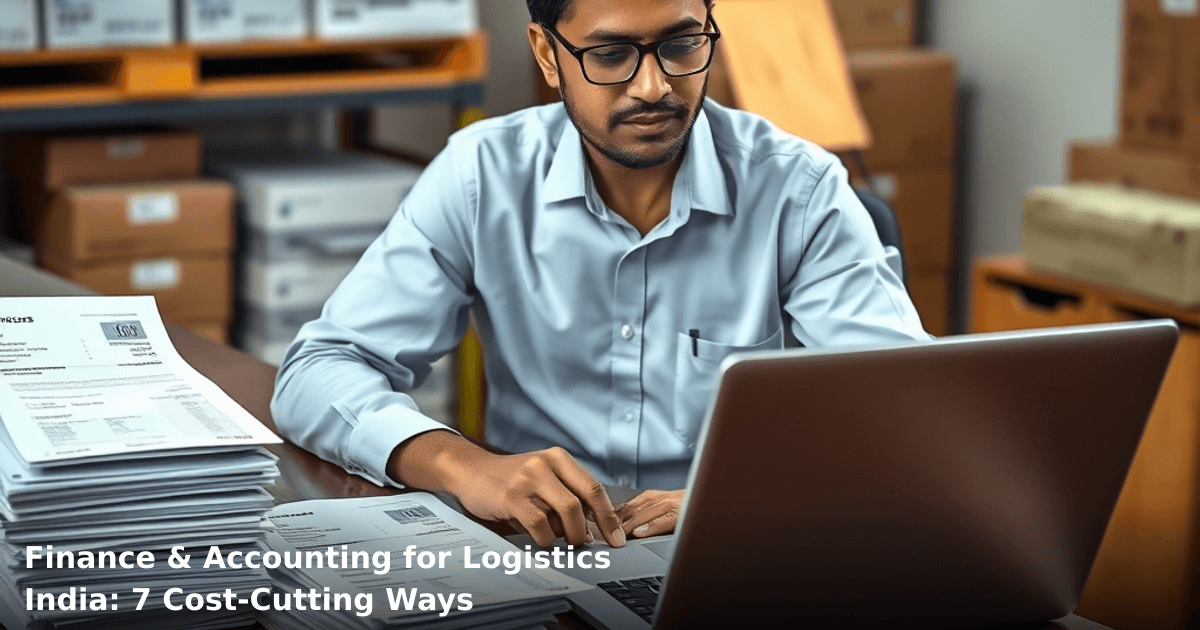
7 Ways Finance & Accounting for Logistics India Cuts Costs
Finance & accounting for logistics India is where most businesses leave money on the table. You're running trucks, managing inventory, tracking GST across multiple states, and still doing payroll on paper or Excel. Your accountant calls every quarter asking for invoices. Your cash flow reports arrive three weeks late. By then, you've already overspent on fuel, overcharged customers, or missed a payment deadline.
The thing is: logistics businesses have unique accounting headaches. Multi-state operations mean GST complications. Fuel price swings hit your margins hard. Driver advances, vehicle maintenance, and toll payments scatter across different ledgers. One of our clients in Bangalore—a 40-truck operation—was spending ₹2.8 lakh monthly just on manual accounting and reconciliation. After implementing proper finance & accounting systems for their logistics business, they cut that to ₹80,000 and caught a ₹15 lakh billing error they'd been missing for two years.
Quick Answer: Finance & accounting for logistics India can cut costs by 25–45% through automation, real-time GST tracking, better fuel expense management, and faster invoice reconciliation. Most logistics SMBs save ₹1.5–3 lakh per month by moving from manual spreadsheets to integrated accounting systems. Implementation takes 3–4 weeks.
Why Finance & Accounting Matters for Indian Logistics Businesses
The Real Cost of Manual Accounting
You're probably tracking expenses across multiple spreadsheets. One sheet for fuel, another for tolls, another for driver advances. Your accountant spends two days per month just consolidating numbers. GST filing happens manually, and you're always worried about missing an invoice or duplicate entry.
According to a NASSCOM report, 68% of Indian logistics SMBs still use Excel for accounting. That creates three problems: human error (costing 2–3% of revenue in mistakes), delayed reporting (cash flow decisions happen too late), and compliance risk (GST audits catch discrepancies months later).
What Proper Systems Do Differently
When you have integrated finance & accounting for logistics India in place, every transaction—fuel card swipe, toll payment, invoice entry—flows into one system. Your GST is calculated automatically. Your profit margin per route is visible in real-time. You know which customers are slow payers before they become a problem.
A Pune-based 3PL provider we worked with was losing ₹4,000–6,000 monthly per truck just from billing errors and duplicate charges. After implementing proper accounting systems, they recovered ₹8.2 lakh in the first year from billing corrections alone.
The 7 Cost-Cutting Ways Finance & Accounting Cuts Logistics Costs
1. Real-Time GST Tracking and Automated Filing
The Problem: GST compliance for multi-state logistics is a nightmare. You operate across Maharashtra, Karnataka, Tamil Nadu. Each state has different rules. You're filing manually, recalculating ITC (Input Tax Credit), and praying you don't miss a deadline.
How It Works: Modern accounting systems track every invoice by state and automatically calculate GST liability. When you upload a fuel receipt from Hyderabad or a toll invoice from the Mumbai-Pune highway, the system flags it, calculates ITC, and pre-fills your GSTR-3B.
The Savings: You save 15–20 hours monthly on GST admin work (₹12,000–18,000 in accountant time). You also avoid late-filing penalties (₹100–500 per day per return) and interest on unpaid GST. A Jaipur-based logistics company saved ₹3.2 lakh in penalties over 18 months just by automating GST filing.
2. Fuel Expense Optimization and Route Profitability
The Problem: Fuel is your second-largest cost after wages. You don't know which routes are actually profitable because you're not tracking fuel consumption per trip. Some drivers fill up at expensive pumps. Others siphon fuel. You have no visibility.
How It Works: Finance & accounting systems for logistics India integrate with fuel cards and GPS data. You see fuel cost per kilometer, per route, per driver. The system flags anomalies (a truck using 15% more fuel than average) and calculates profitability after fuel costs.
The Savings: Most logistics businesses cut fuel waste by 8–12% just by having visibility. That's ₹80,000–1.2 lakh per year for a 10-truck fleet. One client in Surat found that three drivers were consistently refueling at premium pumps. Redirecting them to company-approved pumps saved ₹2,400/month.
3. Toll and Vehicle Expense Tracking
The Problem: Tolls, maintenance, insurance, and permits are scattered across receipts, emails, and driver expense claims. You don't know your true cost per vehicle. Drivers submit expense claims weeks late, and you can't verify them.
How It Works: Automated systems capture toll transactions (FASTag integration), maintenance bills, and insurance premiums in one place. Every vehicle has a cost dashboard showing maintenance spend, insurance, and toll expenses. You spot overspending instantly.
The Savings: Better tracking typically reveals 15–20% in duplicate or fraudulent claims. For a 25-truck fleet spending ₹15 lakh annually on tolls and maintenance, that's ₹2.25–3 lakh recovered. You also negotiate better with vendors when you have three months of data showing exactly what you're spending.
4. Invoice Reconciliation and Bad Debt Reduction
The Problem: You invoice customers, but tracking who's paid what is chaotic. Some customers are 60 days overdue. You don't know because you're not following up systematically. Cash flow suffers. You end up taking loans to cover payroll.
How It Works: Accounting systems automatically match incoming payments to invoices. They flag overdue amounts and send automated reminders (via email or WhatsApp) before they become bad debt. You see cash flow projections 30–60 days ahead.
The Savings: Better collection practices typically reduce bad debt by 40–60%. For a ₹50 lakh monthly revenue logistics business, bad debt is usually 2–3% (₹1–1.5 lakh). Cutting that by half saves ₹6–9 lakh annually. Plus, faster collections mean you need less working capital—no emergency loans at 18% interest.
If you're managing multiple customers with varying payment terms, our CRM Development service integrates directly with your accounting system to automate payment reminders and track customer health in real-time.
5. Driver Advance and Petty Cash Management
The Problem: Drivers take advances for fuel, tolls, and food. You hand out ₹500–2,000 per trip. Some drivers never settle accounts. You have no record. Money disappears.
How It Works: Finance & accounting systems for logistics India create a digital ledger for each driver. Advances are logged instantly (even via WhatsApp). Expenses are matched against advances automatically. Settlements happen weekly with clear documentation.
The Savings: Better tracking prevents 20–30% of advance losses (embezzlement, poor record-keeping). A 30-truck fleet giving ₹1,000 per trip per truck = ₹30,000 daily in advances. If 25% is lost to poor tracking, that's ₹7,500/day or ₹2.25 crore annually. Even a 5% improvement saves ₹11.25 lakh/year.
6. Payroll Accuracy and Compliance
The Problem: You have drivers, mechanics, office staff. Payroll includes fixed salary, dearness allowance (DA), performance bonuses, and statutory deductions. Manual payroll means errors, delayed salaries, and unhappy staff. Compliance with Udyam registration and labor laws is messy.
How It Works: Integrated payroll systems calculate salary automatically based on attendance, performance metrics, and statutory rules. They generate salary slips, maintain compliance records, and file statutory returns (PF, ESI, GST on salary) automatically.
The Savings: Payroll errors cost 2–4% of total payroll in corrections, disputes, and re-processing. For a 50-person logistics team with ₹25 lakh monthly payroll, that's ₹5,000–10,000 in monthly waste. Automation also reduces compliance penalties (₹1,000–10,000 per violation). One client in Chennai saved ₹1.8 lakh in penalties over one year just by filing statutory returns on time.
7. Financial Reporting and Profitability Insights
The Problem: You don't know if you're actually making money. You have a feeling business is good, but your accountant takes six weeks to give you a profit-and-loss statement. By then, the quarter's over.
How It Works: Modern systems give you real-time dashboards. You see revenue, expenses, and profit margin daily. You can drill down to see profitability by route, customer, or vehicle. You spot trends instantly.
The Savings: Better insights lead to smarter pricing and cost control. One Hyderabad-based logistics firm discovered that 15% of their routes were actually unprofitable (they were undercharging). By repricing those routes, they added ₹2.3 lakh monthly profit without changing operations.
Comparison Table: Manual vs. Automated Finance & Accounting for Logistics
| Metric | Manual (Excel/Paper) | Automated System |
|---|---|---|
| Time to close books | 15–20 days | 2–3 days |
| GST filing errors | 5–8% (penalties ₹5,000–50,000) | <0.5% (auto-calculated) |
| Bad debt rate | 2.5–3.5% | 0.8–1.2% |
| Fuel waste detection | None (hidden) | Real-time alerts |
| Driver advance losses | 20–30% | 2–5% |
| Payroll errors | 3–5% | <0.5% |
| Monthly accounting cost | ₹25,000–40,000 | ₹8,000–12,000 |
| Cash flow visibility | Monthly (delayed) | Daily (real-time) |
| Audit readiness | Poor (scrambling) | Excellent (always ready) |
Step-by-Step Guide: Implementing Finance & Accounting for Logistics India
Ready to scale your business systematically?
We combine software, automation, and marketing to build growth systems that work while you sleep.
Step 1: Audit Your Current System (Week 1)
Map out where your data lives right now. Spreadsheets? Tally? Multiple apps? Talk to your accountant and operations team. Identify pain points: What takes the most time? Where do errors happen? What compliance issues keep you up at night?
Time: 2–3 days. Cost: None (internal).
Step 2: Choose the Right Accounting System (Week 1–2)
For Indian logistics SMBs, you have options:
- Tally Prime: Familiar to Indian accountants, handles GST well, but limited automation.
- Zoho Books: Cloud-based, good for small to mid-size logistics, integrates with CRM.
- SAP or Oracle NetSuite: For larger fleets (50+ vehicles), more complex.
For most logistics SMBs, Zoho Books or a custom ERP works best because you can integrate fuel tracking, GPS data, and customer billing.
Time: 1 week. Cost: ₹5,000–50,000 (depending on system).
Step 3: Integrate Your Data Sources (Week 2–3)
Connect fuel cards, toll systems (FASTag), bank accounts, and customer billing. Set up automated data feeds so transactions flow in without manual entry.
Time: 1–2 weeks. Cost: ₹10,000–30,000 (API integration, setup).
Step 4: Set Up Chart of Accounts and Automation Rules (Week 3)
Create a proper chart of accounts for logistics (fuel, tolls, maintenance, driver advances, etc.). Define automation rules: "When a fuel card transaction comes in, tag it as fuel expense and link it to the vehicle." This is where the magic happens.
Time: 3–4 days. Cost: None (internal or consultant time).
Step 5: Train Your Team (Week 3–4)
Your accountant, operations manager, and finance person need to understand the new system. Run a 2–3 hour workshop. Show them how to enter data, run reports, and flag issues.
Time: 1 week. Cost: ₹5,000–10,000 (trainer time, optional).
Step 6: Go Live and Monitor (Week 4 onwards)
Run parallel processing for one month: keep your old system running while testing the new one. Compare reports. Fix discrepancies. Once you're confident, switch fully.
Time: 2–4 weeks. Cost: None (internal monitoring).
Step 7: Optimize and Scale (Month 2 onwards)
Now that data flows automatically, use it. Review profitability weekly. Adjust pricing. Cut wasteful routes. Add new automation rules as you discover patterns.
Time: Ongoing. Cost: None (analysis is now free).
Common Mistakes to Avoid
Mistake 1: Choosing a system based on price alone. A ₹2,000/month accounting tool that doesn't integrate with your fuel card or customer billing wastes more time than it saves. Invest in integration capability.
Mistake 2: Not cleaning up data before migration. If your old system has duplicate invoices or mismatched entries, they'll migrate too. Spend a week cleaning before you switch.
Mistake 3: Skipping the training phase. Your team will resist change. They'll say "the old system was faster." It wasn't—they were just used to it. Proper training cuts resistance by 80%.
Mistake 4: Automating everything at once. Start with GST and payroll (high-impact, low-risk). Then add fuel tracking and invoice matching. Don't try to automate 10 things in week one.
Mistake 5: Not reviewing reports regularly. The system gives you data, but you have to act on it. Schedule a weekly 30-minute review: check cash flow, flag overdue invoices, review fuel costs. This is where ROI happens.
Mistake 6: Ignoring compliance updates. GST rules change. Payroll rules change. Your system needs quarterly updates. Budget ₹5,000–10,000 annually for compliance maintenance.
Key Takeaways
- Finance & accounting for logistics India cuts costs by 25–45% through automation, real-time tracking, and better decision-making.
- Real-time GST tracking saves 15–20 hours monthly and prevents ₹1–5 lakh in penalties annually.
- Fuel and vehicle tracking typically saves 8–12% on fuel waste and reveals 15–20% in duplicate expenses.
- Better invoice and collection processes reduce bad debt by 40–60%, freeing up ₹6–9 lakh annually.
- Automated payroll and driver advance tracking prevents 20–30% in losses and compliance penalties.
- Real-time profitability dashboards help you reprice routes and cut unprofitable services, adding ₹2–3 lakh monthly profit.
- Implementation takes 3–4 weeks, costs ₹20,000–80,000 (one-time), and pays back in 2–3 months.
Frequently Asked Questions
Quick answers about finance-accounting-logistics-india
01 How much can I actually save on fuel costs by implementing proper logistics accounting? ›
Most logistics operators we work with see 8-12% fuel cost reduction within 3 months of tracking trip-wise consumption against distance benchmarks. For a fleet of 10 vehicles burning ₹5 lakh monthly on fuel, that's ₹40,000-60,000 back in your pocket—just by identifying which routes are inefficient and which drivers are over-consuming. The key is real-time mileage reconciliation against invoiced fuel purchases, which catches leakage you're probably bleeding right now.
02 How long does it take to see ROI after implementing specialized logistics accounting software? ›
You'll see meaningful cost identification within 30-45 days, but real ROI (15-20% overall cost reduction) typically shows up in months 3-4 after your team stops fighting the system and starts using the data. The first month is always rough—your accountant will resist, drivers will complain about tracking—but by week 6, when you catch your first major billing error or fuel theft, everyone gets it. Most of my clients break even on software costs (₹15,000-25,000/month for mid-size fleets) by month 2.
03 Is specialized logistics accounting worth it for a small fleet of just 3-4 vehicles? ›
Honestly, not yet—wait until you hit 6-8 vehicles or ₹8-10 lakh monthly turnover. Below that, basic GST-compliant bookkeeping in Tally is enough. But the moment you scale to 8+ vehicles, you're losing ₹30,000-50,000 monthly to untracked maintenance, fuel variance, and billing errors that a ₹20,000/month accounting service would catch immediately. Start building the discipline now with manual tracking so the transition is smooth.
04 What's the biggest mistake logistics owners make with their accounting that actually costs them money? ›
Not separating trip-wise costs from fixed overhead—so they underbid contracts by 15-20% because they genuinely don't know their per-kilometer true cost. I see owners quoting ₹40/km when their actual cost (fuel, maintenance, depreciation, driver) is ₹55/km. Proper logistics accounting forces you to calculate this, and suddenly you realize you need to either raise rates by 12-18% or cut unprofitable routes. This single fix has added ₹1-2 lakh monthly profit for clients without adding a single vehicle.
05 What's the first step to get started if I've never tracked logistics costs properly? ›
Start with a spreadsheet (or Tally if you're already using it) that captures: trip date, vehicle registration, starting odometer, ending odometer, fuel filled (liters and ₹), maintenance spend, and revenue earned. Do this manually for 2-3 weeks across your entire fleet—it's painful but reveals your real cost structure immediately. Once you have 2-3 weeks of clean data, you'll know whether software investment makes sense, and your accountant will have actual numbers to build proper costing on instead of guessing.
Need this built for your business?
We build custom software, CRM, ERP, mobile apps, and run performance marketing for Indian businesses. Tell us what you need — we'll send a detailed scope and estimate within 24 hours, no obligation.
- Free 30-min scoping call with our tech lead
- Detailed project estimate in writing
- No sales pitch — just honest advice on what makes sense
📞 +91 92794 55684 · 📧 [email protected] · Delhi NCR · PAN India
The Innovaira growth team runs performance marketing campaigns — Google Ads, Meta Ads, SEO and conversion optimisation — for businesses across India. Data-driven, ROI-accountable, DPIIT-recognised startup.