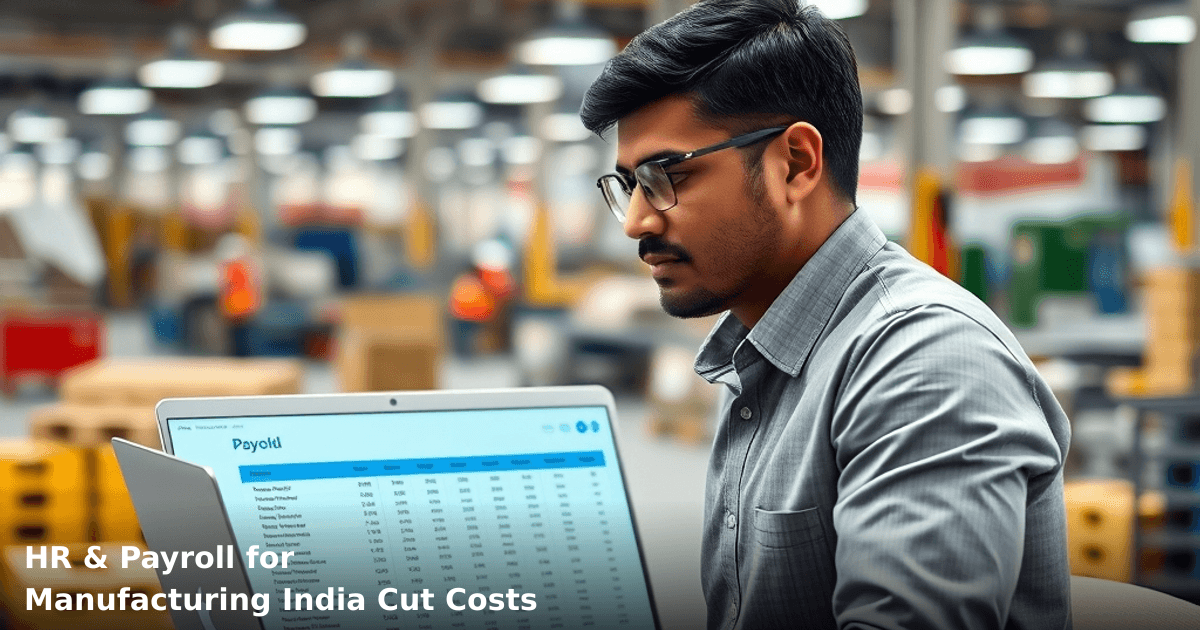
7 Ways HR & Payroll for Manufacturing India Cut Costs
HR & payroll for manufacturing India is eating into your margins — and not because your workforce is expensive. It's the admin overhead. Manual salary calculations, compliance spreadsheets, attendance tracking, statutory deductions, provident fund management, and the constant fear of GST or TDS errors. We've worked with textile units in Surat, auto-component makers in Pune, and food processors in Nashik. Most of them were spending ₹40,000–₹80,000 per month just managing payroll across spreadsheets and external consultants.
Quick Answer: Modern HR and payroll automation systems cut manufacturing payroll costs by 35–50% by eliminating manual data entry, automating compliance, and reducing errors. Indian manufacturing businesses using integrated systems report savings of ₹2–₹5 lakhs annually, plus 15–20 hours of admin time per month recovered.
Why HR & Payroll Matters for Indian Manufacturers
Your manufacturing floor runs on precision. Machines are calibrated. Production schedules are optimized. But your back office? It's probably stuck in 2015.
Manufacturing businesses in India operate under a unique compliance maze: GST, TDS, ESIC, PF contributions, state-level labour laws, and sector-specific regulations. A McKinsey report noted that Indian SMBs lose 18–22% of operational efficiency to administrative overhead — much of it in payroll and HR functions.
The problem compounds when you're scaling. At 10 employees, you can manage payroll in Excel. At 50 employees, you're drowning. At 100+, you need a system or you'll face statutory penalties that dwarf your savings.
The Real Cost of Manual Payroll
- Error rate: 8–12% of manual payroll entries contain mistakes (NASSCOM survey data on Indian SMB operations)
- Time spent: 3–4 hours per week for one person managing 30–50 employees
- Compliance risk: One missed PF deposit or incorrect TDS can trigger ₹50,000–₹2 lakhs in penalties
- Staff turnover: HR teams burn out chasing spreadsheets instead of building culture
What HR & Payroll Automation Actually Does
HR and payroll for manufacturing India isn't just about salary slips. It's a system that connects attendance, leaves, statutory deductions, bank transfers, compliance reports, and employee self-service in one place.
Here's what a proper system handles:
- Automatic salary calculation — basic, DA, HRA, deductions, allowances, all configured once
- Statutory compliance — PF, ESIC, GST, TDS, LIC, gratuity calculations done automatically
- Attendance integration — connects biometric or card-based systems to payroll
- Leave management — tracks leaves, calculates encashment, prevents overpayment
- Bank file generation — creates NEFT/RTGS files for bulk salary transfers
- Compliance reports — generates Form 16, Form 12BA, ESIC statements, PF registers automatically
- Employee portal — staff can check salary slips, leaves, and update personal details themselves
- Audit trail — every change is logged for compliance audits
How It Connects to Your Existing Systems
If you're already using a CRM or ERP for inventory and production, a modern payroll system integrates with it. Employee data flows from your ERP, production data (overtime, shift differentials) feeds into payroll, and financial data syncs to your accounting software. No re-entry. No reconciliation headaches.
Our CRM Development and ERP Development services often include payroll module integration for manufacturing clients — it's one of the quickest wins for operational efficiency.
7 Ways HR & Payroll for Manufacturing India Cut Costs
1. Eliminate Manual Data Entry (Save ₹15,000–₹25,000/month)
Most manufacturing units still maintain parallel systems: biometric data in one place, leave records in another, salary calculations in Excel, and statutory reports in a third. Every month, someone re-enters data three times.
Automation pulls attendance directly from your biometric system, leave approvals happen in the software, and payroll calculates automatically. No re-entry.
Real example: A 45-person automotive parts manufacturer in Bangalore was spending 8 hours/week on data entry alone. After implementing an integrated payroll system, that dropped to 1 hour/week. At ₹400/hour for HR staff time, that's ₹28,000/month recovered.
2. Reduce Compliance Errors and Penalties (Save ₹50,000–₹3 lakhs annually)
One missed PF contribution or incorrect TDS deduction can trigger a compliance notice. We've seen penalties ranging from ₹25,000 to ₹1.5 lakhs for a single error.
Modern payroll systems enforce compliance rules automatically. PF contributions are calculated correctly. TDS is withheld per current slabs. ESIC deductions stop once the ceiling is hit. GST is calculated on salary advances if applicable. No manual interpretation. No errors.
Real example: A food processing unit in Nashik had a TDS error that resulted in a ₹62,000 penalty notice. After implementing automated payroll, they had zero compliance issues in the next 18 months.
3. Recover 15–20 Hours of HR Time Per Month
Your HR person (or team) spends time that should go to hiring, training, and retention on payroll admin. That's a waste.
Automated systems handle salary slip generation, statutory report filing, and employee queries through a self-service portal. Your HR team focuses on culture, grievances, and growth.
Time breakdown before automation:
- Salary calculations: 6 hours
- Compliance report generation: 4 hours
- Employee queries and corrections: 3 hours
- Bank file preparation: 2 hours
- Total: 15 hours/week
Time breakdown after automation:
- System monitoring and exceptions: 1 hour
- Employee queries: 1 hour
- Total: 2 hours/week
That's 52 hours/month. At ₹500/hour average HR cost, that's ₹26,000/month in recovered capacity.
4. Automate Leave and Attendance Tracking (Save ₹8,000–₹12,000/month)
Manual leave tracking breeds disputes. "I took 3 days last month." "Our records show 2." Disputes escalate. HR spends time investigating.
An automated system is the source of truth. Employees request leaves in the system. Managers approve. The system tracks balance, prevents over-leave, and calculates encashment automatically. No disputes.
Plus, when leaves sync with attendance, you catch patterns: someone always takes leaves on Mondays, or someone's biometric isn't being marked. Early warning signs.
Real example: A textile manufacturing unit in Surat had a 15-person HR team. After implementing leave automation, they reduced one full-time HR role (₹12,000/month) because the system handled 80% of the tracking and queries.
5. Generate Statutory Reports in Minutes, Not Days (Save ₹10,000–₹15,000/month in external consultant fees)
Most manufacturing units hire external consultants to prepare Form 16, Form 12BA, ESIC statements, PF registers, and other compliance reports. That costs ₹8,000–₹15,000/month.
A good payroll system generates these reports automatically. Your accountant or HR team reviews them, signs off, and files. No external consultant needed.
Real example: An auto-component maker in Pune was paying an external payroll consultant ₹14,000/month. After implementing an in-house system, they reduced that to ₹2,000/month for quarterly audits only. Savings: ₹12,000/month.
6. Prevent Overpayment and Salary Advance Errors (Save ₹5,000–₹10,000/month)
When employees leave mid-month, get promoted, or take advances, manual calculations often get it wrong. You overpay. You have to recover it. It becomes a mess.
Automated systems calculate pro-rata salaries, deduct advances correctly, and flag overpayments before they happen. Accuracy.
7. Enable Bulk Salary Transfers and Reduce Banking Fees (Save ₹2,000–₹4,000/month)
If you're paying salaries individually, you're paying per-transaction fees. If your bank charges ₹20 per NEFT, and you have 50 employees, that's ₹1,000/month just in fees.
Modern payroll systems generate bulk payment files (NEFT, RTGS, or direct credit) that most banks accept for free or at a flat rate. Plus, you get confirmations and reconciliation automatically.
Comparison Table: HR & Payroll Solutions for Manufacturing India
| Feature | Manual (Excel + Consultant) | Basic Payroll Software (Tally, local tools) | Cloud-Based Integrated System |
|---|---|---|---|
| Setup Time | 2–3 weeks | 1–2 weeks | 3–5 days |
| Monthly Cost | ₹8,000–₹15,000 (consultant) | ₹2,000–₹5,000 | ₹3,000–₹8,000 |
| Compliance Reports | Manual, error-prone | Semi-automated | Fully automated |
| Employee Self-Service | None | Limited | Full portal |
| Integration with ERP/CRM | None | Limited | Full |
| Scalability | Poor (breaks at 50+ staff) | Moderate | Excellent |
| Data Security | Local files (risky) | Local + backup | Cloud + encryption |
| Time Per Month | 15–20 hours | 8–10 hours | 2–3 hours |
Step-by-Step Guide for Indian Manufacturing SMBs
Ready to scale your business systematically?
We combine software, automation, and marketing to build growth systems that work while you sleep.
Step 1: Audit Your Current Payroll Process
Before choosing a system, map what you're doing now:
- How many employees? (This determines system complexity and cost)
- What are your statutory requirements? (GST, TDS, ESIC, PF, state-specific rules)
- What systems do you already use? (ERP, CRM, accounting software)
- Where are your pain points? (Manual errors, compliance delays, staff turnover)
- What's your current monthly payroll admin cost? (Staff time + consultant fees)
Write this down. It becomes your requirements document.
Step 2: Choose a System Aligned to Manufacturing
Not all payroll systems suit manufacturing. You need:
- Shift and overtime management — manufacturing often runs multiple shifts
- Production-linked incentives — some roles get bonuses tied to output
- Statutory compliance for factory workers — ESIC, PF, bonus calculations differ for factory vs. office staff
- Integration with attendance systems — biometric, card readers, or IoT devices
- Batch processing capability — you need to process 50–500 salaries in one go
Popular options for Indian manufacturing:
- Tally Prime (if you're already on Tally; limited but familiar)
- Zoho Payroll (cloud-based, integrates with Zoho CRM/ERP)
- Keka (designed for Indian compliance, good for 20–500 staff)
- Greytip (factory-specific, used by large manufacturing units)
- Custom ERP payroll modules (if you're building or upgrading your ERP)
Step 3: Ensure Compliance Configuration
This is non-negotiable. Work with your accountant or a payroll consultant to configure:
- Salary structure — basic, DA, HRA, allowances, deductions specific to your company
- Statutory deductions — PF slabs, ESIC thresholds, TDS rates (update these every financial year)
- Gratuity and bonus calculations — as per your policy and state law
- Leave encashment rules — how many leaves can be carried forward, encashment rates
- Special allowances — shift differentials, production bonuses, etc.
This takes 1–2 weeks. Don't rush it. Wrong configuration = wrong payroll.
Step 4: Integrate with Your Attendance System
If you have a biometric system or card reader, the payroll software should pull attendance automatically:
- Biometric devices — most modern systems support common brands (ZKTeco, Anviz, etc.)
- Manual entry option — for small teams or remote workers
- Approval workflow — managers approve attendance before payroll runs
This integration saves the most time. Verify it works before going live.
Step 5: Run a Pilot with a Small Batch
Don't go live with 200 employees on day one. Start with 20–30.
- Generate sample salary slips
- Verify calculations against your manual records
- Check compliance reports (Form 16, ESIC, PF registers)
- Test bank file generation
- Get employee feedback on the self-service portal
Iron out issues before scaling. This takes 1–2 payroll cycles (30–60 days).
Step 6: Train Your HR Team and Employees
Your HR team needs to know:
- How to enter new employee data
- How to approve leaves and attendance corrections
- How to handle salary advances and deductions
- How to generate and file compliance reports
- How to troubleshoot common issues
Your employees need to know:
- How to check salary slips
- How to request leaves
- How to update personal information
- How to raise payroll queries
Allocate 2–3 hours for training per person. Provide a user guide.
Step 7: Go Live and Monitor
Once you're confident, move all employees to the system. But don't disappear:
- Monitor the first 2–3 payroll cycles closely
- Track error rates and compliance issues
- Gather feedback from HR and employees
- Make adjustments as needed
After 3 months, you should be running payroll with minimal manual intervention.
Common Mistakes to Avoid
Mistake 1: Choosing a system based on price alone
Cheap systems often lack compliance features or integration capability. You'll end up maintaining parallel systems. A ₹5,000/month system that saves you ₹20,000/month in time and errors is better than a ₹1,500/month system that creates headaches.
Mistake 2: Not configuring statutory rules correctly
If your TDS or PF calculations are wrong from day one, you'll face compliance penalties later. Spend time on configuration. Verify with your accountant.
Mistake 3: Skipping the pilot phase
Going live with 200 employees without testing is risky. Run a pilot with 20–30 first.
Mistake 4: Not integrating with your existing systems
If your payroll system doesn't talk to your ERP or accounting software, you're creating more work, not less. Integration is non-negotiable.
Mistake 5: Ignoring employee data security
Payroll data includes bank account numbers, Aadhaar numbers, and salary information. Ensure your system is encrypted, backed up, and compliant with data protection standards. Cloud systems are generally safer than local Excel files.
Mistake 6: Not updating statutory rules annually
Tax slabs, PF rates, ESIC thresholds, and gratuity calculations change every year. Your system needs to be updated. Many businesses forget and end up with incorrect deductions.
Mistake 7: Underestimating implementation time
Most businesses think they can go live in 2 weeks. Reality: 4–6 weeks is typical for a proper rollout. Plan accordingly.
Key Takeaways
- HR & payroll for manufacturing India saves 35–50% in administrative costs when automated properly — typically ₹2–₹5 lakhs annually for a 50–100 person unit
- Manual payroll errors cost you ₹50,000–₹3 lakhs per year in compliance penalties; automation eliminates 90%+ of errors
- You recover 15–20 hours of HR time per month, which you can redeploy to hiring, training, and retention
- Compliance reports that take days manually are generated in minutes with automation
- Integration with your ERP or CRM is essential — payroll shouldn't be a separate system
- The real ROI isn't just time saved; it's risk reduced — no more compliance penalties, no more overpayments, no more disputes
- Implementation takes 4–6 weeks for a proper rollout, not 2 weeks; plan accordingly
- Choose a system designed for Indian manufacturing, not a generic payroll tool
Frequently Asked Questions
Quick answers about hr-payroll-manufacturing-india
01 How much will switching to an automated HR & payroll system actually save my manufacturing unit? ›
Most mid-sized manufacturing units (50-200 workers) spend ₹8-12 lakhs annually on manual payroll processing, compliance errors, and HR admin overhead—switching to automation cuts this by 40-60%, saving ₹3.2-7.2 lakhs yearly while eliminating costly statutory penalties that average ₹50,000-2 lakhs per violation. You'll also recover 15-20 hours per week of HR staff time that can be redirected to recruitment or worker retention initiatives.
02 How long does it typically take to implement HR & payroll software in a manufacturing setup? ›
Implementation takes 4-8 weeks for most manufacturing SMBs—the first 2 weeks are data migration and system configuration, weeks 3-4 involve staff training and parallel testing, and weeks 5-8 are live deployment with your first payroll cycle. The timeline extends to 10-12 weeks only if you're managing multiple shifts, complex incentive structures, or have 500+ employees across multiple locations.
03 Is automated HR & payroll really worth it for a small 25-person manufacturing workshop? ›
For units under 30 people, you're borderline—if you're growing or planning to hire beyond 40 within 18 months, implement now (ROI hits in 14-16 months); but if you're stable at 20-25 workers indefinitely, a basic cloud payroll tool costing ₹3,000-5,000/month is sufficient rather than a full HR suite at ₹8,000-15,000/month. The real advantage kicks in once you cross 40 employees or have compliance complexity like multiple salary structures or shift allowances.
04 What's the biggest mistake manufacturing owners make when implementing HR software? ›
The most costly mistake is treating it as just a payroll tool—90% of manufacturing SMBs fail to use the attendance, leave, and performance modules, missing out on the actual cost savings from reduced absenteeism (which costs manufacturers 8-12% of productivity) and better shift planning. You'll see real ROI only if you enforce daily attendance tracking and integrate it with your production scheduling, not just run payroll through it.
05 What's the first step to get started with HR & payroll automation for my 60-person manufacturing unit? ›
Start by auditing your current payroll costs and compliance gaps—spend 1 week documenting your salary structure, shift patterns, statutory deductions, and past penalties; then request demos from 2-3 vendors (TalentDesk, Keka, Zoho People are solid for manufacturing) and negotiate a 3-month trial at ₹5,000-8,000/month before committing. Don't buy based on features alone—choose the vendor whose support team has worked with manufacturing units and understands your specific shift and incentive complexity.
Need this built for your business?
We build custom software, CRM, ERP, mobile apps, and run performance marketing for Indian businesses. Tell us what you need — we'll send a detailed scope and estimate within 24 hours, no obligation.
- Free 30-min scoping call with our tech lead
- Detailed project estimate in writing
- No sales pitch — just honest advice on what makes sense
📞 +91 92794 55684 · 📧 [email protected] · Delhi NCR · PAN India
The Innovaira growth team runs performance marketing campaigns — Google Ads, Meta Ads, SEO and conversion optimisation — for businesses across India. Data-driven, ROI-accountable, DPIIT-recognised startup.