
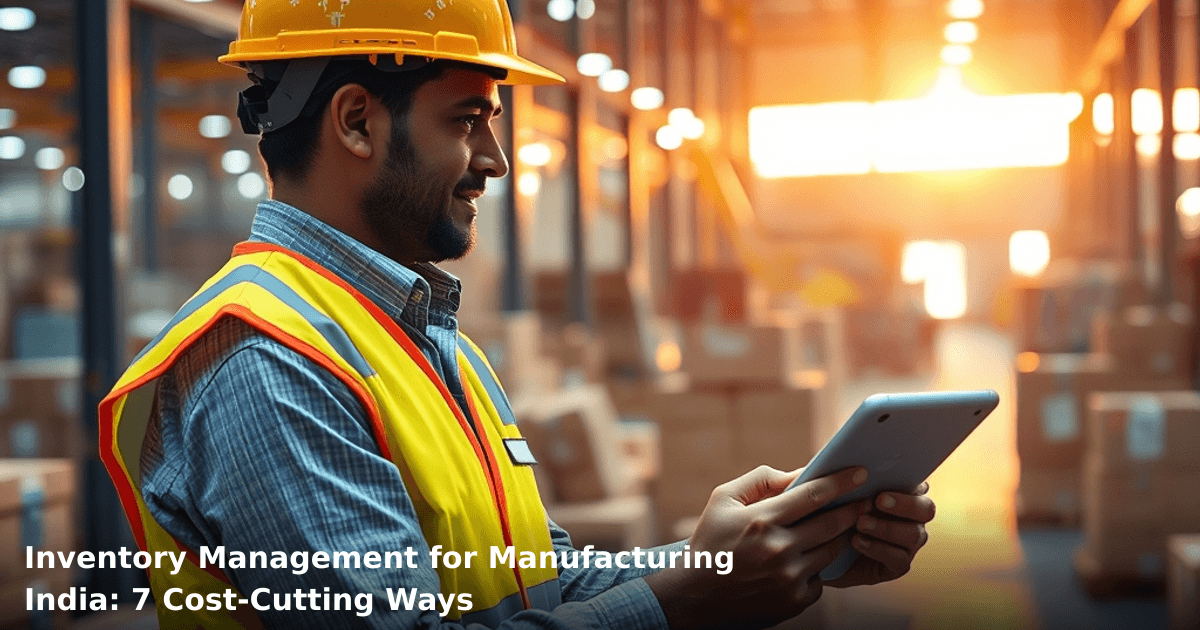
7 Ways Inventory Management for Manufacturing India Cuts Costs
You're sitting in your factory in Pune or Surat, and your production manager just told you that ₹4.5 lakh worth of raw materials are gathering dust in the warehouse. Meanwhile, you're paying rush orders to suppliers because you can't find what you need on the shelf. This is the inventory management crisis facing 73% of Indian manufacturing SMBs right now.
Inventory management for manufacturing India isn't just about tracking stock levels. It's about stopping money from sitting idle, preventing stockouts that halt production, and eliminating the waste that erodes your margins. We've watched textile exporters, automotive component makers, and food processors waste anywhere from 12–18% of their annual revenue on poor inventory practices—and then recover it within 6 months using the right system.
Quick Answer: Inventory management for manufacturing India reduces costs through automated stock tracking, demand forecasting, and JIT (Just-In-Time) ordering. Most Indian manufacturers see cost reductions of 15–25% within the first year, saving ₹2–5 lakh monthly depending on production volume. Implementation takes 4–8 weeks with the right ERP or inventory software.
Why Inventory Management Matters for Indian Businesses
The Real Cost of Poor Inventory Control
You're not just losing money on obsolete stock. Poor inventory management for manufacturing India creates a domino effect: delayed orders → unhappy customers → lost contracts. Add in GST compliance headaches, spoilage in warehouses without climate control, and manual counting errors, and you're bleeding cash.
According to a McKinsey report, manufacturers with weak inventory systems lose 8–12% of revenue annually. For a ₹50 lakh revenue business, that's ₹4–6 lakh gone. For a ₹1 crore operation, it's ₹8–12 lakh.
Why Indian Manufacturers Struggle
Three reasons stand out:
- Manual systems still dominate. Many tier-2 and tier-3 manufacturers still use handwritten ledgers or basic spreadsheets. One data entry error cascades into production delays.
- Seasonal demand swings. If you're in textiles, auto parts, or food production, demand isn't steady. Without forecasting, you either over-stock (tying up capital) or under-stock (losing sales).
- Supplier inconsistency. Raw material availability fluctuates, delivery times vary, and prices shift with commodity markets. Without visibility, you can't plan ahead.
What Inventory Management for Manufacturing India Actually Does
The Three Pillars
Real-time stock visibility: You know exactly what's in your warehouse, where it is, and its age. No more "Did we order this?" moments.
Demand forecasting: Historical sales data + seasonal patterns = accurate predictions of what you'll need next month.
Automated reordering: When stock hits a preset threshold, the system flags it. Some systems integrate with suppliers' APIs to auto-place orders.
7 Ways Inventory Management for Manufacturing India Cuts Costs
1. Eliminate Dead Stock and Obsolescence
Dead stock—materials that haven't moved in 90+ days—ties up capital and takes warehouse space. We worked with a textile exporter in Surat who discovered ₹18 lakh in obsolete yarn sitting on shelves. It had been there for 18 months.
With proper inventory management for manufacturing, you:
- Tag items with purchase date and movement history
- Flag slow-moving stock automatically
- Liquidate or repurpose before it becomes a write-off
Savings: 2–5% of total inventory value recovered within 3 months.
2. Reduce Carrying Costs
Carrying costs include warehouse rent, climate control, insurance, and handling labor. They typically run 20–35% of your inventory value annually in India.
Inventory management systems cut this by:
- Reducing overall stock levels (you don't over-buy "just in case")
- Identifying fast-moving vs. slow-moving items
- Optimizing warehouse space—no more wasted shelves
A Pune-based automotive component supplier cut warehouse rent by ₹1.8 lakh/month by reducing inventory by 40% after implementing an ERP system.
Savings: ₹80,000–2 lakh/month for mid-sized manufacturers.
3. Prevent Stockouts and Rush Orders
When you run out of a critical component mid-production, you either halt the line (losing ₹5,000–15,000/hour in lost output) or pay 2–3x normal price for emergency delivery.
Inventory management for manufacturing India prevents this by:
- Forecasting demand based on historical trends
- Setting reorder points automatically
- Tracking lead times from suppliers
You order before you're desperate, not after.
Savings: ₹1–3 lakh/year per production line by eliminating emergency purchases.
4. Optimize Working Capital
Your cash is locked in inventory. The faster you turn that inventory into finished goods and sales, the faster cash comes back.
Inventory Turnover Ratio = Cost of Goods Sold ÷ Average Inventory Value
With better management:
- You reduce average inventory value
- You increase turnover ratio
- Your cash cycle shrinks
Example: A ₹2 crore business with a 6-month cash cycle could free up ₹30–50 lakh by reducing the cycle to 4 months.
Savings: Direct improvement in cash flow; no interest on working capital loans.
5. Cut Procurement and Administrative Costs
Manual ordering means multiple emails, phone calls, spreadsheet updates, and invoice reconciliation. Inventory management systems automate this.
Automated workflows:
- Generate purchase orders automatically
- Match invoices to orders (reducing billing disputes)
- Track supplier performance (on-time delivery, quality)
One manufacturing partner in Bangalore saved 120 hours/month (₹2.4 lakh annually in labor) by automating their procurement process.
Savings: ₹1.5–3 lakh/year in reduced administrative overhead.
6. Reduce Waste and Spoilage
In food, pharma, and chemical manufacturing, spoilage is brutal. Items expire, degrade, or get damaged. FIFO (First In, First Out) tracking prevents this.
Inventory management systems:
- Track expiry dates automatically
- Flag items nearing expiration
- Ensure FIFO compliance for GST audits
A food processor in Nashik reduced waste by 8% (₹3.2 lakh/year) just by implementing FIFO tracking and setting up alerts for expiring stock.
Savings: 3–10% reduction in spoilage, depending on product type.
7. Improve Forecasting and Demand Planning
Guessing demand is expensive. Inventory management systems use historical data to predict what you'll need.
Better forecasting means:
- Smaller, more frequent orders (reducing bulk-buy waste)
- Aligned production schedules (no idle machines or rush overtime)
- Better supplier negotiations (you know your volume 3–6 months ahead)
According to a Gartner report, manufacturers with demand forecasting see 15–25% reductions in excess inventory and 10–20% improvements in on-time delivery.
Savings: ₹2–5 lakh/month for mid-sized operations through reduced overstock and overtime.
Comparison Table: Inventory Management Approaches for Indian Manufacturers
Ready to scale your business systematically?
We combine software, automation, and marketing to build growth systems that work while you sleep.
| Approach | Setup Time | Monthly Cost | Accuracy | Scalability | Best For |
|---|---|---|---|---|---|
| Manual (Spreadsheets) | 1 week | ₹0 | 60–70% | Up to 500 SKUs | Micro businesses (<₹20L revenue) |
| Tally + Manual Processes | 2 weeks | ₹500–1,000 | 75–80% | Up to 2,000 SKUs | Small manufacturers (<₹1Cr revenue) |
| Basic Inventory Software | 3–4 weeks | ₹3,000–8,000 | 85–90% | Up to 5,000 SKUs | Mid-sized (₹1–5Cr revenue) |
| Full ERP System | 6–10 weeks | ₹12,000–25,000 | 95%+ | 10,000+ SKUs | Large/complex (₹5Cr+ revenue) |
| ERP + WhatsApp Integration | 8–12 weeks | ₹15,000–30,000 | 96%+ | Unlimited | Multi-location, B2B + B2C |
Step-by-Step Guide for Indian SMBs
Step 1: Audit Your Current Inventory
Before buying software, understand what you have:
- List all SKUs (stock-keeping units)
- Count physical inventory (do a full stock-take)
- Identify slow-moving and dead stock
- Record supplier lead times and minimum order quantities
- Document your current ordering process (how long does it take?)
Timeline: 1–2 weeks Outcome: You'll know your baseline costs and pain points.
Step 2: Define Your Inventory Goals
What do you want to achieve?
- Reduce inventory by 20%?
- Cut stockouts from 8/month to 1/month?
- Free up ₹50 lakh in working capital?
- Reduce waste from 5% to 2%?
Write these down. You'll measure progress against them.
Timeline: 3–5 days Outcome: Clear KPIs (Key Performance Indicators) for success.
Step 3: Choose the Right System
For most Indian SMBs, you have three realistic options:
Option A: Cloud-based inventory software (e.g., Zoho Inventory, SAP Analytics Cloud) Pros: Quick setup (2–4 weeks), affordable (₹3,000–8,000/month), easy to use Cons: Limited customization, may need additional modules for manufacturing
Option B: ERP system (e.g., Odoo, ERPNext, Tally Prime with modules) Pros: Integrated with accounting, GST-ready, scalable Cons: Longer setup (6–10 weeks), higher cost (₹12,000–25,000/month)
Option C: Custom development Pros: Built exactly for your workflow Cons: Expensive (₹3–8 lakh upfront), takes 8–12 weeks
For most tier-2 and tier-3 manufacturers, Option B (ERP) is the sweet spot. If you're still on manual systems, start with Option A and upgrade later.
Timeline: 1 week to decide Outcome: System selected and vendor shortlisted.
Step 4: Set Up Stock Categories and Reorder Points
Not all inventory is created equal. Categorize by:
- A items: High-value, critical (e.g., specialized components) → tight control, frequent counts
- B items: Medium value, moderate criticality → standard controls
- C items: Low-value, low criticality (e.g., nuts, bolts) → loose controls
For each category, set:
- Minimum stock level (reorder point)
- Maximum stock level (to prevent over-buying)
- Lead time (days until supplier delivers)
- Safety stock (buffer for demand spikes)
Formula: Reorder Point = (Average Daily Usage × Lead Time in Days) + Safety Stock
Example: If you use 50 units/day, supplier takes 10 days, and you want 5 days of safety stock: Reorder Point = (50 × 10) + (50 × 5) = 750 units
Timeline: 2–3 weeks Outcome: Reorder rules built into your system.
Step 5: Integrate with Suppliers and Accounting
Connect your inventory system to:
- Supplier data: Lead times, MOQs (minimum order quantities), pricing
- Accounting software: Auto-sync purchase orders and invoices
- Production planning: Link inventory to production schedules
If you have multiple locations, connect them all so stock can be transferred between warehouses without manual paperwork.
Timeline: 2–3 weeks Outcome: Automated workflows; less manual data entry.
Step 6: Train Your Team and Go Live
Your warehouse staff, procurement team, and production managers need to use the system correctly. Poor adoption kills ROI.
- Conduct 2–3 training sessions (1 hour each)
- Create a simple SOP (Standard Operating Procedure) document
- Assign an internal "inventory champion" to troubleshoot
- Run parallel testing for 1–2 weeks (old system + new system) before full cutover
Timeline: 1–2 weeks Outcome: Team confident and system live.
Step 7: Monitor and Optimize
After 30 days, review:
- Inventory turnover ratio (did it improve?)
- Stockout frequency (fewer emergencies?)
- Carrying costs (warehouse spend down?)
- Data accuracy (are counts matching?)
Adjust reorder points, safety stock, and supplier relationships based on real data.
Timeline: Ongoing, monthly reviews Outcome: Continuous improvement; costs keep dropping.
Common Mistakes to Avoid
Mistake 1: Implementing Without Cleaning Up Data First
Garbage in, garbage out. If your current inventory data is messy (duplicate SKUs, wrong quantities, missing supplier info), the new system will amplify the problem.
Fix: Do a full audit and cleanup before going live. Takes 2 weeks but saves months of headaches.
Mistake 2: Over-Buying "Safety Stock"
Some manufacturers set safety stock at 30–50% of average usage, thinking it prevents stockouts. It doesn't—it just ties up capital.
Fix: Use demand forecasting data to calculate safety stock scientifically. For most items, 10–20% is enough.
Mistake 3: Ignoring Seasonal Demand Patterns
If you're in textiles, auto parts, or FMCG, demand swings 40–60% between seasons. A flat reorder point won't work.
Fix: Adjust reorder points quarterly based on seasonal forecasts.
Mistake 4: Poor Supplier Communication
If your suppliers don't know you're using JIT ordering, they'll think you're reducing their business. They may increase MOQs or prices.
Fix: Communicate early. Explain that you're ordering more frequently but with predictable volumes.
Mistake 5: Neglecting Obsolete Stock
Once dead stock piles up, it's hard to move. Liquidate it early—even at 40% of cost—rather than let it rot.
Fix: Monthly reviews of slow-moving items. Set a 90-day threshold; anything older gets flagged for action.
Key Takeaways
- Inventory management for manufacturing India reduces costs by 15–25% within the first year through eliminating dead stock, reducing carrying costs, and preventing stockouts.
- Seven specific levers cut costs: eliminating dead stock (₹2–5 lakh recovered), reducing carrying costs (₹80K–2L/month), preventing emergency orders (₹1–3L/year), optimizing working capital, cutting procurement overhead (₹1.5–3L/year), reducing spoilage (3–10%), and improving demand forecasting (₹2–5L/month).
- Most Indian SMBs benefit from a cloud ERP system (₹12,000–25,000/month, 6–10 week setup) rather than custom development or basic spreadsheets.
- Implementation is a 7-step process: audit current inventory, define goals, choose a system, set reorder points, integrate with suppliers, train your team, and monitor monthly.
- Common mistakes—over-buying safety stock, ignoring seasonality, poor supplier communication—can wipe out your gains. Avoid them by using data, not gut feel.
Frequently Asked Questions
Quick answers about inventory-management-for-manufacturing-india
01 How much can I actually save by implementing proper inventory management in my manufacturing unit? ›
Most Indian SMBs we've worked with see 15-25% reduction in working capital tied up in inventory within the first year — that's typically ₹8-15 lakhs freed up for a mid-sized unit with ₹50 lakh annual inventory. Beyond that, you'll cut carrying costs (storage, insurance, obsolescence) by ₹2-4 lakhs annually, plus reduce production delays that cost roughly ₹500-1000 per hour of downtime.
02 How long does it actually take to see results after setting up an inventory system? ›
You'll spot quick wins within 30-45 days — mainly from eliminating duplicate orders and reducing manual errors — but meaningful cost reduction takes 4-6 months as your team adapts to the system and you optimize reorder points. Most manufacturers hit their full ROI (usually 18-24 months payback) by month 8-10, assuming you're tracking at least 70% of your SKUs actively.
03 Is inventory management software really necessary for my small 10-person manufacturing workshop, or is Excel enough? ›
Excel works until you hit roughly ₹30-40 lakh annual turnover with 50+ SKUs; beyond that, manual tracking creates 8-12 hours of weekly admin work and error rates jump to 15-20%. If you're below that threshold but growing fast, investing ₹15,000-30,000 annually in basic cloud inventory software now saves you from rebuilding processes later when scaling becomes painful.
04 We've heard that just buying better warehouse software will fix our inventory problems — is that true? ›
No — this is the biggest mistake I see; software alone fixes maybe 20% of the problem, while 80% comes from discipline in data entry, accurate cycle counts, and realistic demand forecasting. I've seen units spend ₹2 lakhs on software that sits unused because their team still manually tracks stock on paper; the real cost is training your people (2-3 weeks) and redesigning your processes first.
05 What's the first step I should take if I want to start cutting inventory costs this quarter? ›
Start by doing a physical stock count and comparing it to your books — you'll likely find 10-15% discrepancies that reveal where leaks are happening. Then pick your top 20% of SKUs (usually 80% of your value) and implement basic reorder point calculations for just those; this takes 1-2 weeks and typically frees up ₹1-2 lakhs immediately without any software investment.
Need this built for your business?
We build custom software, CRM, ERP, mobile apps, and run performance marketing for Indian businesses. Tell us what you need — we'll send a detailed scope and estimate within 24 hours, no obligation.
- Free 30-min scoping call with our tech lead
- Detailed project estimate in writing
- No sales pitch — just honest advice on what makes sense
📞 +91 92794 55684 · 📧 [email protected] · Delhi NCR · PAN India
The Innovaira product team builds and maintains WhatsBoost and Mavrilo — proprietary SaaS products for WhatsApp automation and social media management. ISO 27001:2022 certified for information security.