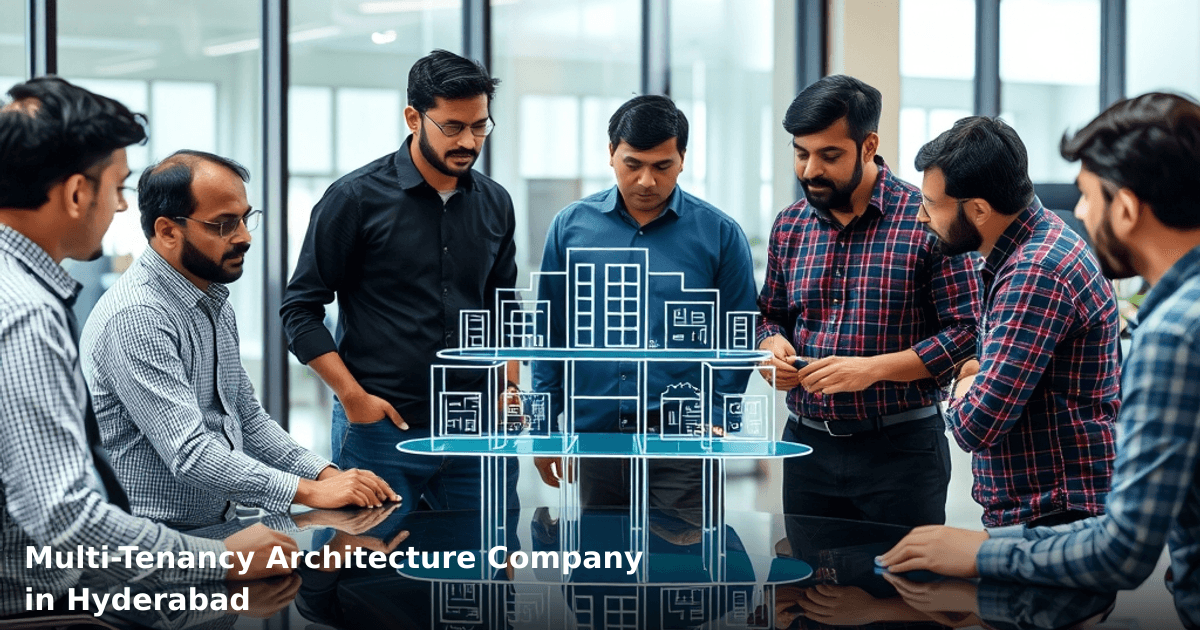
Best Multi-Tenancy Architecture Company in Hyderabad: How to Choose
When you're building a SaaS product or scaling your business software, multi-tenancy architecture in Hyderabad, India is one of the most critical decisions you'll make—yet most SMBs get it wrong. A multi-tenancy architecture allows multiple customers to use the same software instance while keeping their data completely isolated, which can cut your infrastructure costs by 60–70% compared to single-tenant setups. But choosing the right partner to build it? That's where most businesses stumble.
Quick Answer: Multi-tenancy architecture in Hyderabad is a system design where one software instance serves multiple customers with isolated data and configurations. It typically costs ₹15–40 lakhs to build properly and takes 4–6 months for a mid-market SaaS product. Choose a partner with proven experience in database isolation, API design, and Indian compliance (GST, RBI guidelines).
Why Multi-Tenancy Architecture Matters for Indian Businesses
Your software's architecture isn't just technical jargon—it directly affects your profit margins, customer acquisition speed, and ability to scale. Here's why it matters to you specifically.
The Cost Reality
A Gartner report showed that Indian SaaS startups using multi-tenancy architecture reduced their per-customer infrastructure costs by 65% within the first year. If you're running a single-tenant system for 20 customers on AWS, you're probably paying ₹3–5 lakhs monthly. With proper multi-tenancy, that drops to ₹1–1.5 lakhs for the same customer base.
Speed to Market
We worked with a HR tech startup in Hyderabad last year. They had built a single-tenant system and were spending 3 weeks per customer deployment. After migrating to a multi-tenant architecture, new customer onboarding took 2 days. That's the difference between acquiring 5 customers a month and 40.
Competitive Advantage
According to a NASSCOM report, 78% of Indian SaaS companies that adopted multi-tenancy architecture in their first product iteration were able to raise Series A funding faster than those who started single-tenant. Why? Because investors see it as proof of scalable thinking.
What Is Multi-Tenancy Architecture and How Does It Work?
Let's be clear about what we're talking about, because "multi-tenancy" gets thrown around loosely and often incorrectly.
The Three Models
Model 1: Shared Database, Shared Schema All customers share the same database tables. You add a customer_id column to every table. Cheapest to build (₹8–12 lakhs). Highest security risk. If one query breaks, it breaks for everyone. Not recommended unless you have fewer than 50 customers and zero compliance requirements.
Model 2: Shared Database, Separate Schemas Each customer gets their own database schema within the same database server. Better isolation. Easier to migrate a customer later. Costs ₹18–28 lakhs. This is what most mature Indian SaaS companies use.
Model 3: Separate Databases Each customer gets their own database instance. Maximum isolation and security. Costs ₹30–45 lakhs and takes 5–6 months. Required if you're handling sensitive financial or healthcare data, or if you're selling to enterprises with strict data residency requirements.
How Data Isolation Actually Works
When a customer logs in, your system identifies them (via JWT token, session, or API key). Every query automatically filters by that customer ID. A customer from Bangalore can't see data from a customer in Pune—not because of UI tricks, but because the database literally won't return those rows. It's enforced at the query level.
This is why choosing the right architecture company matters. A poorly built system might look isolated at the UI level but have data leaks at the database level. We've audited systems where a clever user could change a URL parameter and see another customer's data.
Comparison Table: Multi-Tenancy Architecture Models for Indian Businesses
| Aspect | Shared DB, Shared Schema | Shared DB, Separate Schemas | Separate Databases |
|---|---|---|---|
| Build Cost | ₹8–12 lakhs | ₹18–28 lakhs | ₹30–45 lakhs |
| Build Time | 2–3 months | 3–4 months | 5–6 months |
| Data Isolation | Weak (code-level only) | Strong (schema-level) | Maximum (database-level) |
| Scaling Difficulty | Easy initially, breaks at 500+ customers | Moderate, scales to 5,000+ customers | Complex, but enterprise-grade |
| Cost per Customer (Annual) | ₹2,000–4,000 | ₹4,000–8,000 | ₹8,000–15,000 |
| Backup/Migration Complexity | Simple | Moderate | Complex |
| Best For | Early-stage startups (<50 customers) | Growing SaaS, SMB tools | Enterprise SaaS, regulated industries |
| Compliance Ready? | No | Partially (needs audit) | Yes |
Step-by-Step Guide: How to Choose a Multi-Tenancy Architecture Company in Hyderabad
Building a SaaS product? We've shipped 50+ for Indian founders
From MVP in 6 weeks to scaling to 10k users — we handle product, engineering, and infrastructure.
1. Verify Their Technical Depth
Ask them this: "Walk me through your approach to row-level security and how you prevent data leaks between tenants."
If they hesitate, move on. A real company will explain database isolation strategies, role-based access control (RBAC), and how they test for cross-tenant data access. We've seen companies in Hyderabad that claim multi-tenancy expertise but have never actually implemented schema-level separation.
Red flag: If they say "we just add a customer ID column and you're good." Green flag: If they discuss database views, row-level security policies, and mention testing frameworks like Cypress for multi-tenant scenarios.
2. Check Their Experience with Indian Compliance
Multi-tenancy isn't just about code—it's about GST, data residency, and RBI guidelines if you're handling financial data.
Ask: "How do you handle GST calculations for multi-tenant systems where customers operate in different states?"
Or: "Have you built systems that comply with RBI's data localization requirements?"
A company worth hiring will have handled these. We've seen systems where GST was calculated at the global level (wrong) instead of per-tenant (correct). For a fintech startup in Hyderabad, that mistake cost ₹8 lakhs in refunds and penalties.
3. Request a Case Study Specific to Your Industry
Don't accept generic case studies. If you're building an inventory management SaaS, ask for a case study from another inventory company. If you're in HR tech, ask for HR tech examples.
Why? Because multi-tenancy architecture requirements differ wildly by industry. A B2B SaaS for logistics has completely different scaling and reporting needs than a B2B2C platform for beauty salons.
One of our clients, a fintech startup in Hyderabad, hired a company with great multi-tenancy credentials but zero fintech experience. They built a system that couldn't handle concurrent transactions properly. Cost them 6 months of rework.
4. Evaluate Their DevOps and Infrastructure Knowledge
Multi-tenancy architecture lives or dies based on infrastructure decisions. Ask:
- "How do you handle database backups for isolated schemas?"
- "What's your strategy for scaling databases when we hit 10,000 customers?"
- "How do you monitor per-tenant performance without one tenant's spike affecting others?"
If they can't answer these clearly, they're not ready. Multi-tenancy isn't just a database design—it's a full-stack commitment from database to load balancer to monitoring.
5. Check Their Post-Launch Support
Building multi-tenancy is 40% of the work. The other 60% is monitoring, optimizing, and handling edge cases that only appear when you have 500+ customers.
Ask: "What does your support look like after launch? How do you handle performance issues that only affect specific tenants?"
A good company will have monitoring dashboards, alerting systems, and a clear SLA for critical issues. They should also offer quarterly architecture reviews as your customer base grows.
Common Mistakes to Avoid When Choosing a Multi-Tenancy Architecture Partner
Mistake 1: Hiring Based on Price Alone
We see this constantly. A startup in Bangalore gets quoted ₹45 lakhs by one company and ₹18 lakhs by another, then picks the cheaper option. Six months later, they're rebuilding because the cheaper option used shared schemas without proper isolation.
Multi-tenancy architecture isn't a commodity. The difference between ₹18 lakhs and ₹35 lakhs is usually the difference between "it works for 100 customers" and "it scales to 10,000 customers without breaking."
Mistake 2: Not Planning for Multi-Tenancy from Day One
If you build single-tenant first and plan to "migrate to multi-tenancy later," you're adding ₹15–20 lakhs to your eventual costs and 4–6 months of lost time. Your entire codebase needs to be architected around multi-tenancy from the beginning.
Mistake 3: Skipping the Security Audit
Before launch, insist on a third-party security audit specifically for multi-tenant data isolation. It costs ₹2–3 lakhs but could save you from a data breach that costs ₹50+ lakhs in fines and reputation damage.
Mistake 4: Not Documenting Tenant Isolation Policies
After launch, your team needs clear documentation about how data isolation works, who can access what, and what queries are safe. We've seen companies lose customers because their support team accidentally exposed another customer's data while troubleshooting.
Mistake 5: Choosing a Company Without Local Market Understanding
A company that's built multi-tenancy for US SaaS companies might not understand GST, UPI payment flows, or how Indian businesses handle multi-location operations. Hyderabad has excellent talent, but make sure they've worked with Indian businesses specifically.
Key Takeaways
- Multi-tenancy architecture reduces per-customer infrastructure costs by 60–70% compared to single-tenant systems, making it critical for SaaS profitability.
- Choose between three models: shared database with shared schema (₹8–12 lakhs, risky), shared database with separate schemas (₹18–28 lakhs, recommended for most), or separate databases (₹30–45 lakhs, enterprise-grade).
- Verify technical depth by asking about row-level security, database isolation, and how they test for cross-tenant data leaks. Red flags include vague answers or oversimplification.
- Ensure compliance expertise with GST, data residency, and RBI guidelines—especially critical for fintech, healthcare, or regulated industries in India.
- Request industry-specific case studies, not generic ones. Multi-tenancy requirements vary significantly by business type.
- Evaluate DevOps and infrastructure knowledge. Multi-tenancy is a full-stack commitment, not just database design.
- Plan for post-launch support including monitoring, performance optimization, and quarterly architecture reviews as you scale.
- Never hire based on price alone. The difference between ₹18 lakhs and ₹35 lakhs is often the difference between breaking at 500 customers and scaling to 10,000.
Frequently Asked Questions
Quick answers about multi-tenancy-architecture-hyderabad
01 How much will a multi-tenancy architecture setup cost us, and what's included in that ₹ amount? ›
A basic multi-tenancy implementation in Hyderabad typically runs ₹8-15 lakhs for a mid-market SaaS platform, covering database design, tenant isolation, and initial deployment—but expect ₹25-40 lakhs if you need advanced features like real-time analytics per tenant or custom billing engines. The biggest cost trap SMBs hit is underestimating infrastructure: many quote only development but forget that multi-tenancy demands robust DevOps, monitoring tools (₹2-3 lakhs annually), and security audits (₹3-5 lakhs), which can double your total investment.
02 How long does it actually take to migrate our existing single-tenant system to multi-tenancy? ›
For a typical Indian SMB with 50-100 existing customers, expect 4-6 months of active development plus 2-3 months of parallel testing before full cutover—that's why most Hyderabad firms recommend a phased rollout where you move 20% of customers every 4-6 weeks rather than a big bang migration. I've seen companies underestimate by 40-50% because they don't account for data cleansing, tenant-specific customizations, and the inevitable production issues that emerge during live migration.
03 Is multi-tenancy architecture actually worth it for a 20-person startup with just 15-20 customers right now? ›
Not yet—multi-tenancy only makes financial sense when you're managing 50+ customers or expect to hit that within 12 months, because the complexity cost (₹10-15 lakhs upfront) won't pay back until you're scaling customer acquisition. If you're still in product-market fit phase with 15-20 customers, stick with single-tenancy for another 6-8 months, then reassess; the real ROI hits when your customer support, infrastructure, and sales costs drop by 30-40% due to multi-tenant efficiency.
04 We've heard multi-tenancy means we can just "flip a switch" and instantly serve unlimited customers—is that true? ›
That's the biggest misconception I encounter, and it causes real damage: multi-tenancy handles logical separation beautifully, but your database still has physical limits, your API can still get rate-limited, and you'll absolutely hit scaling walls around 500-1000 concurrent users unless you've also invested in load balancing, caching (Redis/Memcached), and database sharding. I've seen Hyderabad startups launch multi-tenancy proudly, then crash when their 50th customer brought real load—they'd optimized the architecture but skipped infrastructure scaling.
05 What's the first step we should take if we decide multi-tenancy is right for our business? ›
Start with a technical audit (₹1-2 lakhs, 2-3 weeks) where a Hyderabad firm maps your current database schema, identifies which customer data must be isolated versus shared, and flags customization points—this prevents costly rework later and often reveals that 60-70% of your codebase can stay unchanged. Only after this audit should you pick between database-per-tenant (most secure, highest cost) or schema-per-tenant (best balance for SMBs) or row-level security (cheapest but requires discipline).
Need this built for your business?
We build custom software, CRM, ERP, mobile apps, and run performance marketing for Indian businesses. Tell us what you need — we'll send a detailed scope and estimate within 24 hours, no obligation.
- Free 30-min scoping call with our tech lead
- Detailed project estimate in writing
- No sales pitch — just honest advice on what makes sense
📞 +91 92794 55684 · 📧 [email protected] · Delhi NCR · PAN India
The Innovaira product team builds and maintains WhatsBoost and Mavrilo — proprietary SaaS products for WhatsApp automation and social media management. ISO 27001:2022 certified for information security.