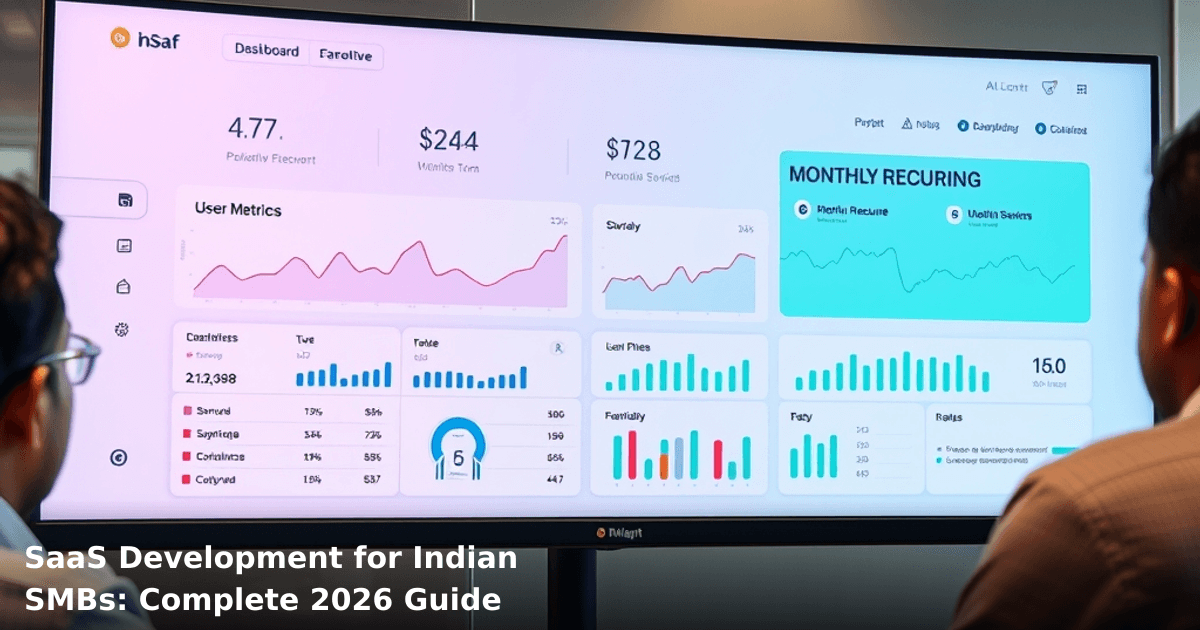
SaaS development for Indian SMBs is no longer a luxury—it's how you compete. But here's the problem: you're either paying ₹3–5 lakhs/month for enterprise software that's bloated for your team size, or you're stitching together free tools that break under load. Neither scales.
Quick Answer: SaaS development means building cloud-based software tailored to your business—no installation, automatic updates, works from anywhere. For Indian SMBs, it costs ₹50,000–₹2,50,000 to build, then ₹8,000–₹30,000/month to run. The payoff: 40–60% faster operations and zero server headaches.
Why SaaS Development Matters for Indian Businesses
You're running a textile business in Tiruppur, a pharma distributor in Hyderabad, or a logistics startup in Pune. Your team uses spreadsheets, Tally, WhatsApp, and email. Nothing talks to anything. Your accountant enters data three times. Your sales team doesn't know what inventory you have. Your customer data lives in five different apps.
This is where SaaS development changes the game.
The Real Cost of Not Having Custom SaaS
According to a NASSCOM report, 67% of Indian SMBs waste 15–20 hours per week on manual data entry and duplicate work. That's ₹30,000–₹60,000 per month in lost productivity. Add in the cost of hiring someone just to manage your software stack, and you're bleeding money without knowing it.
A manufacturing unit in Pune we worked with was managing orders through email, inventory in Tally, and invoices in another system. No one knew the real stock position. They lost ₹1.2 lakh in a single month due to overselling. After we built them a custom SaaS platform that synced all three, they cut order-to-delivery time by 45% and eliminated overselling entirely.
What SaaS Development Actually Is (and Why It's Different)
SaaS development isn't just "software in the cloud." It's software designed for your specific workflow, built to integrate with tools you already use, and deployed so your team can access it from anywhere—on desktop, mobile, or tablet.
How It Differs From Off-the-Shelf Software
Off-the-shelf (like Zoho CRM or Freshworks): Pre-built, one-size-fits-all, ₹5,000–₹25,000/month, limited customization.
Custom SaaS development: Built for your business, integrates with your existing tools, scales with your growth, costs ₹50,000–₹2,50,000 upfront, then ₹8,000–₹30,000/month to run.
Think of it this way: off-the-shelf is buying a readymade suit. Custom SaaS is a tailored one. The suit fits better, lasts longer, and you don't have to compromise on buttons or pockets.
The Three Layers of SaaS Development
1. The Frontend (What Your Team Sees) Your dashboard, forms, reports, mobile app. This is where your team lives. It needs to be fast, intuitive, and work on slow internet (because tier-2 cities in India still deal with 3G on bad days).
2. The Backend (The Engine) Databases, APIs, security, integrations with your existing tools—Tally, WhatsApp, Google Sheets, payment gateways, UPI. This is where the real work happens. Most SMBs don't see this, but they feel it when it breaks.
3. Infrastructure (Where It Lives) Cloud servers, backups, security, compliance (GST, data localization). You don't manage this—your SaaS vendor does. No more "the server is down" at 2 AM.
Comparison: SaaS Development vs. Other Approaches
| Factor | DIY (Spreadsheets + Free Tools) | Freelancer / Agency | Large Enterprise Software | Custom SaaS (Innovaira) |
|---|---|---|---|---|
| Setup Time | 1–2 weeks | 4–8 weeks | 2–3 months | 3–6 weeks |
| Initial Cost | ₹0–₹10,000 | ₹50,000–₹1,50,000 | ₹2–5 lakhs | ₹50,000–₹2,50,000 |
| Monthly Cost | ₹0 (hidden waste) | ₹5,000–₹15,000 | ₹3–5 lakhs | ₹8,000–₹30,000 |
| Customization | None | Limited, breaks easily | Rigid, expensive to change | 100% tailored to your workflow |
| Scalability | Breaks at 50+ users | Breaks at 100+ users | Over-engineered, wasteful | Grows with you |
| Integration | Manual, error-prone | Possible but fragile | Integrates with enterprise tools | Integrates with your tools—Tally, WhatsApp, UPI, GST APIs |
| Security | Risky (no encryption, no backups) | Depends on vendor | Enterprise-grade | Bank-level encryption, daily backups, GDPR-ready |
| Support | None | Freelancer may disappear | Slow, expensive | Dedicated support, 24/7 availability |
Step-by-Step Guide to SaaS Development for Your Business
1. Audit Your Current Workflow (Week 1)
Before a single line of code is written, you need to understand what your team actually does. Not what you think they do—what they really do.
Spend a day with your sales team. Watch how they log a customer. Where does the data go? How many times do they re-enter it? What information do they need that they don't have right now?
Do the same with your operations team, accountant, and warehouse manager. Document every step. Every bottleneck. Every tool they switch between.
This takes 2–3 days but saves you ₹50,000+ in wasted development later.
2. Define Your Core Workflow (Week 1–2)
Now map out your ideal workflow. Not your current broken one—your ideal one.
Example: A textile exporter's ideal workflow might be:
- Customer inquiry comes in via WhatsApp → automatically logged in CRM
- Sales team quotes via the app → customer accepts → order created
- Order syncs to inventory → stock reserved
- Production team sees job card in the app → updates progress
- Invoice auto-generates → customer gets it via WhatsApp
- Payment comes in via UPI → reconciles automatically in Tally export
This is what your SaaS should do. If your current tools require manual steps, your SaaS eliminates them.
3. Choose Your Core Modules (Week 2)
Don't try to build everything at once. Start with your biggest pain point.
For most SMBs, this is one of:
- CRM + Lead Management — if sales is chaotic
- Inventory Management — if you're losing money on stock
- Order Management — if fulfillment is slow
- Billing & Invoicing — if accounting takes too long
We usually recommend starting with one, then adding others. A pharma distributor in Bangalore started with inventory management (they were losing ₹80,000/month to shrinkage). Six months later, they added order management. A year later, CRM.
4. Choose Your Tech Stack and Vendor (Week 2–3)
This is where most SMBs get confused. You'll hear terms like "React," "Node.js," "PostgreSQL," "AWS." Here's what actually matters:
- Speed: Can your team use it on 4G internet? Does it load in under 2 seconds?
- Security: Is it encrypted? Are backups automatic? Is it compliant with GST and data localization rules?
- Integration: Can it talk to Tally, WhatsApp, UPI gateways, Google Sheets?
- Support: If something breaks at 3 PM on a Tuesday, can you get help in 30 minutes?
If you're building with an agency, ask them these questions. If they can't answer clearly, find someone else.
If setting up integrations between your SaaS and existing tools sounds complex, our CRM Development and ERP Development services handle this end-to-end—API integrations, data migration, team training, and ongoing support. We've built systems for textile exporters, pharma distributors, and logistics companies across Delhi NCR and beyond.
5. Build, Test, and Deploy (Week 4–6)
Your vendor builds the app. You don't need to understand the code—you need to understand the timeline.
A realistic timeline:
- Week 1–2: Design + setup
- Week 2–3: Core features built
- Week 3–4: Testing (your team uses it, finds bugs, vendor fixes)
- Week 4–5: Integrations tested
- Week 5–6: Go live
If your vendor promises it in 2 weeks, they're lying or cutting corners.
6. Train Your Team and Monitor (Week 6+)
Your SaaS is only useful if your team actually uses it. Most failures happen here.
Spend a full day training your team. Not a 30-minute Zoom call—a full day. Walk through every feature. Have them do real work in the app while you're there. Answer questions.
For the first month, monitor usage. Are your sales team actually logging leads? Is your warehouse team updating inventory? If not, something's wrong with the app or the training.
Common Mistakes to Avoid
Building a SaaS product? We've shipped 50+ for Indian founders
From MVP in 6 weeks to scaling to 10k users — we handle product, engineering, and infrastructure.
Mistake 1: Building Too Much at Once
You want a CRM, inventory, invoicing, reporting, mobile app, WhatsApp integration, and AI forecasting. All at once.
This turns a 6-week project into a 6-month nightmare. Your budget doubles. Your team gets confused. Nothing works well.
Start with one core module. Get it working perfectly. Then add the next one.
Mistake 2: Choosing Based on Price Alone
A freelancer quotes ₹30,000 total. An agency quotes ₹1,50,000. You pick the freelancer.
Six months later, the freelancer has disappeared. Your app is broken. No one can fix it. You've wasted ₹30,000 and three months of your team's time.
Cheap isn't cheap if it doesn't work or can't be maintained.
Mistake 3: Ignoring Data Migration
You have 10 years of customer data in a spreadsheet. Your new SaaS is empty.
Moving that data isn't just copy-paste. You need to clean it, validate it, map it to the new structure. If you skip this, your reports will be garbage.
Budget ₹20,000–₹50,000 and two weeks for data migration. It's worth it.
Mistake 4: Not Planning for Growth
You build SaaS for 10 users. It works great. You hire 20 more people. Suddenly it's slow, crashes, or costs 3x more to run.
Build for 2x your current team size. It costs maybe 10% more upfront but saves you ₹1,50,000+ in rebuilding later.
Mistake 5: Forgetting About Compliance
Your SaaS handles customer data, payment info, GST invoices. If it's not compliant, you're liable.
Make sure your vendor handles:
- Data localization (servers in India)
- Encryption (data at rest and in transit)
- GST compliance
- GDPR readiness (if you export data)
- Regular security audits
Why Innovaira?
If you're comparing vendors right now, here's what sets us apart:
1. We Know Indian Businesses Specifically We've built SaaS for textile exporters, pharma distributors, logistics startups, and manufacturing units. We understand GST, UPI, Tally integration, tier-2 city internet issues, and the unique challenges of Indian SMBs. We're not a global agency trying to fit you into a template.
2. We Integrate With Tools You Already Use Your team uses Tally, WhatsApp, Google Sheets, UPI gateways. We build SaaS that connects to these, not replaces them. No data silos. No retraining. Your workflow improves, not changes completely.
3. We Price for Your Budget Most agencies charge ₹3–5 lakhs upfront, then ₹30,000–₹50,000/month. We offer custom SaaS starting at ₹50,000 with monthly costs from ₹8,000. Transparent pricing. No hidden fees.
4. We Support You Long-Term We don't disappear after launch. We monitor your system, fix bugs within 24 hours, and help you add features as you grow. One client in Surat has been with us for 3 years—we've added 8 new modules based on their feedback.
5. We Measure Success in Your Numbers We don't care about lines of code. We care about your KPIs: faster order processing, fewer manual errors, lower inventory costs, higher customer satisfaction. We set targets before we build.
Key Takeaways
- SaaS development costs ₹50,000–₹2,50,000 upfront, then ₹8,000–₹30,000/month. It's cheaper than enterprise software and more flexible than off-the-shelf tools.
- Start with your biggest pain point. Don't build everything at once. One module, done well, beats five modules done poorly.
- Data migration and team training matter more than the code. Most SaaS failures happen because teams don't use it, not because it's broken.
- Choose a vendor who understands Indian business context. GST, Tally, UPI, tier-2 city challenges—these aren't edge cases in India, they're the norm.
- Integrate with your existing tools, don't replace them. Your team already uses Tally, WhatsApp, Google Sheets. Your SaaS should work with these, not against them.
- According to a McKinsey report, companies that implemented custom software saw 35–40% improvement in operational efficiency within the first year. For Indian SMBs, this translates to ₹50,000–₹2,00,000 in annual savings.
Frequently Asked Questions
Quick answers about saas-development
01 How much does it actually cost to build a SaaS product for my Indian SMB in 2026? ›
A: You're looking at ₹15-40 lakhs for an MVP (Minimum Viable Product) with a small team of 3-4 developers working for 4-6 months, versus ₹1-2 crores if you hire a premium agency in Bangalore or Mumbai. Most bootstrapped Indian SaaS founders I've worked with start with ₹8-12 lakhs by using no-code tools like Bubble or Webflow for the first version, then migrate to custom code once they have paying customers validating the idea.
02 How long will it take from my idea to actually having customers paying for my SaaS? ›
A: Realistically, 8-12 months if you're building with a dedicated team of 2-3 developers working full-time, but only 3-4 months if you use no-code platforms or hire freelancers from platforms like Toptal or Gun.io at ₹60-100/hour. The biggest time killer isn't coding—it's waiting for customer feedback; most Indian SMB SaaS founders waste 2-3 months building features nobody wants because they didn't validate the market first.
03 Is building a SaaS product realistic for my SMB, or should I stick with services? ›
A: If your SMB has ₹20+ lakhs in annual profit and you can afford to invest ₹15-25 lakhs upfront with zero revenue for 6-9 months, then SaaS makes sense—but only if you're solving a problem you personally experience or see repeatedly in your industry. SaaS is not for you if your business model relies on custom client work; I've seen 70% of Indian SMBs that tried SaaS while maintaining services fail because they couldn't focus on product development while juggling client deliverables.
04 What's the biggest mistake Indian SMB owners make when building SaaS? ›
A: The fatal mistake is building for "everyone"—I see founders from Delhi to Bangalore spend ₹30+ lakhs building a generic inventory management tool when they should've built specifically for textile traders or pharmaceutical distributors first. Most Indian SMB SaaS products fail because founders don't charge enough (pricing at ₹999/month when they should charge ₹5,000+) and they build 50 features instead of 5; your first version should solve ONE problem so well that customers can't live without it.
05 What's the first concrete step I should take to start building my SaaS? ›
A: Stop building and start talking—spend ₹0 for the next 2 weeks interviewing 20-30 potential customers in your target market (your existing network counts) and record exactly what problem costs them time or money monthly. Once you've validated that 8+ people will pay ₹3,000+ monthly for a solution, then invest in either a no-code MVP (₹2-5 lakhs, 4-6 weeks) or hire 2 developers from Upwork/Toptal (₹60-80k/month each) to build your first version while you focus on pre-selling to your first 5 customers.
Need this built for your business?
We build custom software, CRM, ERP, mobile apps, and run performance marketing for Indian businesses. Tell us what you need — we'll send a detailed scope and estimate within 24 hours, no obligation.
- Free 30-min scoping call with our tech lead
- Detailed project estimate in writing
- No sales pitch — just honest advice on what makes sense
📞 +91 92794 55684 · 📧 [email protected] · Delhi NCR · PAN India