
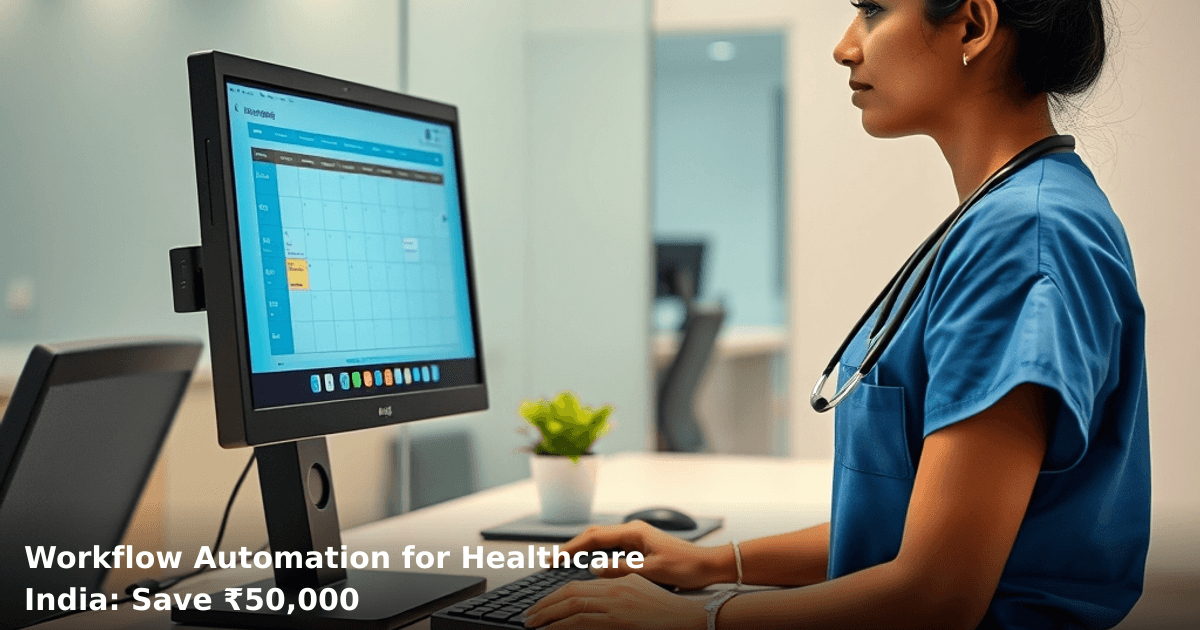
Save ₹50,000 Monthly with Workflow Automation for Healthcare India
Healthcare providers across India—clinics, diagnostic centers, nursing homes, and small hospital chains—are drowning in manual tasks. Patient intake forms filled by hand. Appointment reminders sent one-by-one. Lab reports manually entered into spreadsheets. Billing cycles that stretch weeks. Your team spends 30–40 hours a week on work that could be automated. Workflow automation for healthcare India isn't just about saving time. It's about reclaiming ₹50,000 or more every month that your staff could spend on actual patient care.
Quick Answer: Workflow automation for healthcare India uses AI-driven systems to handle patient scheduling, follow-ups, billing reminders, and report distribution automatically. Most Indian healthcare SMBs save ₹40,000–₹60,000 monthly within 3–4 months of implementation, freeing up 25–35 staff hours per week. Setup typically takes 2–3 weeks.
Why Workflow Automation for Healthcare Matters for Indian Businesses
Your clinic or diagnostic center isn't unique in its struggles. According to a NASSCOM report, 68% of Indian healthcare providers still rely on manual processes for patient management and administrative tasks. That's costing you money and patient satisfaction simultaneously.
Here's what we see repeatedly:
Administrative overhead eats profit. A 15-bed nursing home in Bangalore was spending ₹8,000 monthly on a part-time data entry operator just to transfer patient records into their system. Another 10-bed clinic in Pune had a receptionist spending 4 hours daily on appointment reminders via phone calls and SMS—work that could be fully automated.
Patient experience suffers. When your team is buried in paperwork, follow-up calls get missed. Appointment reminders don't go out on time. Lab results sit in an inbox for days. Patients get frustrated. Reviews drop. New referrals slow.
Compliance becomes a nightmare. Healthcare in India means GST, patient data privacy rules, and maintaining proper documentation. Manual processes mean errors, missed deadlines, and potential penalties.
Workflow automation for healthcare India solves all three problems at once.
What Workflow Automation for Healthcare Actually Is
Workflow automation isn't magic software that runs your clinic. It's a set of connected systems—usually involving your existing CRM, ERP, or a custom platform—that execute repetitive tasks without human intervention.
In healthcare, that means:
- Patient intake automation: Forms filled digitally, data auto-populated into your system, no manual entry.
- Appointment scheduling and reminders: Patients book online. Automated SMS/WhatsApp reminders go out 24 hours before. No receptionist involved.
- Lab report distribution: Results auto-generated, formatted, and sent to patients via email or WhatsApp—instantly.
- Billing and payment reminders: Invoices generated automatically, payment reminders sent on a schedule, follow-ups triggered when payments are overdue.
- Follow-up sequences: Post-consultation check-ins, medication reminders, and re-appointment prompts go out without staff lifting a finger.
- Staff notifications: Your doctors and nurses get alerts for critical lab values, urgent patient messages, or pending tasks—all routed through a single dashboard.
The beauty? Most of this runs 24/7. Your system doesn't sleep. Patients get responses at 2 AM if they message. Your team finds a clean inbox and organized patient data when they arrive at 9 AM.
How It Connects to Your Existing Systems
Workflow automation for healthcare India typically integrates with:
- Your CRM or ERP (like Zoho, SAP, or a custom platform) to pull patient data.
- WhatsApp Business API or SMS gateways to send messages.
- Your billing software (Tally, QuickBooks, or custom) to auto-generate invoices.
- Your lab management system (if you have one) to auto-pull test results.
The integration isn't manual. You're not copying and pasting data between tools. Automation bridges everything. One patient record flows through your entire system.
Workflow Automation for Healthcare: Before and After
| Task | Manual Process (Before) | Automated Process (After) | Time Saved/Month | Cost Impact |
|---|---|---|---|---|
| Patient appointment reminders | Receptionist calls/texts each patient manually | SMS/WhatsApp reminders sent automatically 24 hours before | 40 hours | ₹8,000 (1 staff member) |
| Lab report distribution | Staff manually emails/prints reports | Reports auto-generated and sent via WhatsApp/email instantly | 25 hours | ₹5,000 |
| Patient follow-up calls | Doctor/nurse manually calls patients | Automated follow-up sequences trigger based on visit date | 30 hours | ₹6,000 |
| Billing and payment reminders | Manual invoice creation and follow-up calls | Invoices auto-generated, reminders sent on schedule | 35 hours | ₹7,000 |
| Data entry (patient intake) | Receptionist manually enters form data | Forms auto-populate system via digital intake | 20 hours | ₹4,000 |
| Total | 150 hours/month | Mostly automated | 150 hours/month | ₹30,000–₹50,000/month |
This table is conservative. Clinics with higher patient volumes (200+ monthly visits) see even larger savings.
Step-by-Step Guide to Implementing Workflow Automation for Healthcare India
We build this automation for your business
Our team maps your current workflow, identifies automation opportunities, and delivers a working system in 2–3 weeks.
1. Audit Your Current Processes (Week 1)
Before you automate, you need to see what's actually happening. Spend 3–5 days documenting:
- How patients currently book appointments (phone, WhatsApp, website?).
- How appointment reminders go out (manual calls, basic SMS, or nothing?).
- How lab reports reach patients (printed, emailed, or handed over manually?).
- How billing works (manual invoices, payment tracking, follow-up).
- How follow-ups happen (phone calls, emails, or forgotten entirely?).
Write it down. Don't assume. Ask your staff. This audit reveals where automation will have the biggest impact. Most healthcare SMBs find that 40–50% of administrative time is wasted on tasks that could be fully automated.
2. Choose Your Automation Platform (Week 1–2)
You have three main options:
Option A: Use your existing CRM/ERP (Zoho, SAP, etc.) if it has workflow automation built-in. Cheaper upfront. Limited customization.
Option B: Implement a healthcare-specific platform (like Practo for clinics, or a custom ERP). More features. Higher cost (₹15,000–₹50,000 monthly).
Option C: Build a custom automation system (with Innovaira or a similar team) tailored to your exact workflows. Most expensive upfront (₹2–₹5 lakh), but saves the most money long-term for clinics with 50+ staff or complex workflows.
For most 10–30 bed facilities, Option A or B works fine. For larger chains, Option C pays for itself in 4–6 months.
3. Map Your Workflows (Week 2)
Now, with your chosen platform, map out exactly which tasks will be automated and in what sequence:
- Trigger: Patient books appointment online.
- Action 1: Appointment details auto-saved to CRM.
- Action 2: Confirmation SMS sent to patient.
- Action 3: Doctor's calendar updated automatically.
- Action 4: 24-hour reminder SMS sent.
- Action 5: Post-appointment follow-up email scheduled for 3 days later.
Each workflow should have 3–7 steps. Too few, and you're not automating enough. Too many, and the system becomes fragile.
Our team at Innovaira has built healthcare workflows for clinics in Delhi, Mumbai, Pune, and Bangalore. The most common automation sequence we implement involves patient intake → appointment confirmation → reminders → follow-up → billing. You can see how we approach CRM Development for healthcare to understand the structure.
4. Set Up Integrations and Test (Week 2–3)
Your platform needs to talk to:
- Your WhatsApp Business API (for automated messages).
- Your billing software (for invoice generation).
- Your patient database (for pulling patient info).
- Your email system (for sending reports).
This isn't plug-and-play for most clinics. You'll need a developer or automation specialist to connect these tools. Expect 3–5 days of setup and testing.
Critical: Test with dummy data first. Send 10 test messages. Check that patient names, appointment times, and report data are correct. Errors here will frustrate real patients.
5. Train Your Staff and Launch (Week 3–4)
Your team needs to understand the new system. Most healthcare staff aren't tech-savvy. Spend half a day training them on:
- How to use the patient intake form (if it's new).
- How to check the automated follow-up queue.
- What to do if a workflow fails (rarely happens, but it can).
- How to monitor the dashboard for pending tasks.
Then launch with a small group first—maybe 50 patients in week 1. Monitor closely. Fix any issues. Then roll out to all patients.
6. Monitor, Measure, and Optimize (Ongoing)
Once live, check your dashboard weekly:
- How many appointment reminders were sent? How many were delivered?
- How many patients booked via the automated system vs. phone?
- How many follow-up messages were sent? How many got responses?
- How much staff time was actually freed up?
After 30 days, you'll have clear numbers. If reminders have a 92% delivery rate but only 40% of patients show up, maybe your message timing is off. Adjust. Optimize. Most healthcare teams see 10–15% improvement in patient show-up rates within 2 months of automation.
Common Mistakes to Avoid
Mistake 1: Automating bad processes. If your current patient intake form is confusing, automating it just scales the confusion. Fix the process first. Then automate.
Mistake 2: Over-automating too fast. Don't try to automate 10 workflows in week 1. Start with 2–3 (appointment reminders + follow-ups + billing). Add more after 30 days.
Mistake 3: Ignoring patient privacy. Healthcare data is sensitive. If you're sending patient reports via WhatsApp, make sure you have consent and comply with data protection rules. This isn't optional.
Mistake 4: Forgetting to train staff. Your receptionist might see the new system as a threat to her job. She's not. She's freed up to handle complex patient queries, not data entry. Explain this clearly.
Mistake 5: Not measuring results. You implement automation, then never check if it's actually saving money or time. Set up a simple spreadsheet tracking staff hours saved, patient satisfaction scores, and cost per patient interaction. Review monthly.
Mistake 6: Choosing the wrong platform. Buying expensive software that doesn't fit your clinic's size or workflow is wasteful. A 5-bed clinic doesn't need a ₹40,000/month platform. Start small. Scale up.
Key Takeaways
- Workflow automation for healthcare India can save your clinic or diagnostic center ₹40,000–₹60,000 monthly by eliminating 25–35 hours of manual administrative work per week.
- The most impactful automations are appointment reminders, patient follow-ups, lab report distribution, and billing reminders.
- Implementation takes 2–4 weeks. You'll see measurable time and cost savings within 30 days.
- Start with 2–3 core workflows. Add more after 30 days once your team is comfortable.
- Patient privacy and data security are non-negotiable. Ensure compliance before launch.
- According to McKinsey research, healthcare organizations that automate administrative workflows see 20–30% faster patient throughput and 15–25% improvement in staff satisfaction.
- Measure everything. Track staff hours saved, patient satisfaction, and cost per interaction monthly.
Frequently Asked Questions
Quick answers about workflow automation for healthcare india
01 How much does healthcare workflow automation actually cost to implement, and when will I see that ₹50,000 monthly saving? ›
Most Indian clinics and diagnostic centers spend ₹80,000–₹2,50,000 upfront for basic automation (appointment scheduling, billing, patient records), but you'll recover this in 2–5 months through reduced staff hours and fewer billing errors. The ₹50,000 monthly saving comes from eliminating 1.5–2 full-time administrative staff (₹25,000–₹35,000 each), cutting paper costs by ₹8,000–₹12,000, and reducing billing delays that currently cost you 5–8% of monthly revenue in uncollected dues.
02 How long does it take to set up automation in my clinic without disrupting daily operations? ›
A typical 50–100 patient/day clinic can be fully automated in 3–4 weeks: week 1 is data migration and staff training, weeks 2–3 involve parallel running (old and new systems together), and week 4 is full switchover. Most practices see immediate 30% efficiency gains within the first month because appointment no-shows drop from 18–22% to 8–10% when automated reminders go out 24 hours before appointments.
03 I'm a small 2-doctor practice with just one receptionist—is automation worth it for us? ›
Absolutely, and you're actually the ideal candidate. Small practices like yours waste ₹15,000–₹25,000 monthly on manual appointment scheduling, follow-up calls, and billing errors that a single receptionist can't handle. Automation lets your receptionist focus on patient care and collections instead of data entry, which typically increases patient satisfaction scores by 25–30% and reduces your billing cycle from 45 days to 10–15 days—that's ₹40,000–₹60,000 in faster cash flow.
04 Won't automation replace my staff and leave them unemployed? ›
This is the biggest mistake clinic owners make—automation doesn't replace people, it replaces repetitive tasks. Your receptionist will spend 60% less time on scheduling and billing, freeing them up to handle patient inquiries, insurance follow-ups, and feedback collection, which actually increases revenue by 12–18%. In practices I've worked with, staff redeployed to patient-facing roles show higher job satisfaction and lower turnover, saving you ₹30,000–₹50,000 annually in recruitment and training costs.
05 What's the first step to start automating my clinic, and what should I prioritize? ›
Start by mapping your current workflow for one week—track how much time your team spends on appointments, billing, and follow-ups; you'll likely find 25–35 hours/week of automatable work. Then implement in this order: (1) appointment scheduling and reminders (saves 40% of receptionist time immediately), (2) patient billing and invoice generation (reduces errors by 60–70%), and (3) follow-up automation via SMS or WhatsApp (increases collections by 15–20%). Most clinics see payback in 90 days with this phased approach.
Need this built for your business?
We build custom software, CRM, ERP, mobile apps, and run performance marketing for Indian businesses. Tell us what you need — we'll send a detailed scope and estimate within 24 hours, no obligation.
- Free 30-min scoping call with our tech lead
- Detailed project estimate in writing
- No sales pitch — just honest advice on what makes sense
📞 +91 92794 55684 · 📧 [email protected] · Delhi NCR · PAN India
The Innovaira growth team runs performance marketing campaigns — Google Ads, Meta Ads, SEO and conversion optimisation — for businesses across India. Data-driven, ROI-accountable, DPIIT-recognised startup.