7 Ways Workflow Automation for Logistics India Cuts Costs
Your logistics operation runs 24/7, but your team doesn't. Every day, someone's manually entering shipment data into three different systems. Every hour, a customer chases you for a delivery update that's already in your system — nobody just told them. Every week, you're paying overtime because your team is drowning in paperwork instead of solving real problems.
This is where workflow automation for logistics India changes the game. Not the expensive, six-month implementation kind. The kind that starts working within 2–3 weeks and cuts your operational costs by 35–45% within the first quarter.
Quick Answer: Workflow automation for logistics India reduces manual data entry by 80%, cuts delivery delays by 30%, and saves Indian logistics SMBs ₹40,000–₹1,20,000 per month by automating order processing, tracking, invoicing, and customer notifications. Most businesses see ROI within 90 days.
Why Workflow Automation Matters for Indian Logistics Businesses
Your logistics operation is fundamentally a data relay system. An order comes in. It needs to hit your warehouse management system, your billing software, your driver's mobile app, and your customer's inbox — all without human hands touching it twice.
According to a McKinsey report, Indian logistics companies lose 18–22% of operational efficiency to manual, repetitive tasks. For a mid-sized 3PL handling 500–1,000 shipments daily, that's ₹50,000–₹80,000 in wasted labour every single month.
The second problem: your customers expect real-time updates. A shipper in Bangalore needs to know where their consignment is. Your driver knows. Your warehouse system knows. But getting that information to the customer still takes 4–6 hours because someone has to manually pull a report and send an email or WhatsApp.
Workflow automation for logistics businesses in India solves both problems at once.
What Workflow Automation Actually Is (and Isn't)
Workflow automation isn't hiring a software engineer to build a custom system. It isn't replacing your team. It's building invisible pipelines that move data between your existing tools — your TMS (Transportation Management System), warehouse software, billing platform, and customer communication channels — so humans only handle exceptions.
Here's the difference:
Without automation: Order arrives → Someone logs it in TMS → Someone enters it in warehouse system → Someone sends driver notification → Someone updates customer → Someone generates invoice → Someone reconciles with accounting.
With automation: Order arrives → Automatically syncs across TMS, warehouse, driver app, customer portal, and billing. Your team only steps in if something's wrong.
The best part? You don't need to rip out your existing software. Workflow automation for logistics India works with what you already have — whether it's Tally, SAP, custom TMS, or even WhatsApp for customer communication.
The 7 Ways Workflow Automation Cuts Your Logistics Costs
1. Eliminate Manual Order Entry (Save ₹12,000–₹25,000/Month)
Right now, orders probably arrive via email, phone, or your website. Then someone manually types them into your TMS. Then someone verifies them. Then someone enters them again into your warehouse system.
That's three data entry cycles for one order.
Automation connects your email, website, and customer portal directly to your TMS and warehouse system. An order placed at 2 PM is live in every system by 2:01 PM. No human required.
A logistics operator we worked with in Pune was processing 300 orders daily. Their team spent 4 hours every morning just entering orders. After automation, that dropped to 15 minutes of exception handling. That's 3.75 hours of labour saved per day — roughly ₹18,000/month at ₹150/hour.
The catch: This only works if your systems have APIs or can export/import data. Most modern platforms do. If you're still running on paper or completely manual spreadsheets, you'll need a quick data setup (usually 3–5 days).
2. Auto-Generate and Send Invoices (Save ₹8,000–₹15,000/Month)
Your billing team probably:
- Pulls shipment data from the TMS
- Cross-checks it with warehouse records
- Enters it into your billing software
- Generates an invoice
- Sends it via email
- Waits for customer confirmation
- Reconciles with accounting
That's 6–8 steps per shipment. For 500 shipments daily, that's one full-time person doing just invoicing.
Workflow automation triggers invoice generation the moment a shipment is marked "delivered." The invoice automatically pulls correct rates, taxes, and surcharges from your system, adds GST (calculated based on origin/destination), and emails the customer. Your accounting team gets a notification to reconcile.
A Bangalore-based 3PL saved ₹12,000/month just by automating invoice generation. They went from 2 people handling billing to 1 person handling exceptions.
3. Real-Time Customer Notifications via WhatsApp (Save ₹6,000–₹10,000/Month + Reduce Calls by 40%)
Your customer service team spends 30% of their day answering "Where's my shipment?" calls and emails.
Workflow automation for logistics India can send automated WhatsApp updates at key milestones:
- "Your shipment picked up at 6:30 AM"
- "In transit to Mumbai hub — ETA 2 PM"
- "Out for delivery — driver will call 15 mins before arrival"
- "Delivered at 5:15 PM. Sign here to confirm"
You're not replacing your team. You're just giving customers information before they ask for it.
Our WhatsApp Automation service integrates with your TMS so updates send automatically. One logistics operator in Gurgaon reduced customer service calls by 45% within 60 days. That's ₹8,000/month in saved labour, plus happier customers.
4. Automate Driver Assignment and Route Optimization (Save ₹15,000–₹35,000/Month)
Manual driver assignment is chaos. Your operations manager looks at pending deliveries, checks which drivers are available, considers their current routes, and sends messages to assign trips. This takes 20–30 minutes for 20–30 drivers.
Workflow automation does this in seconds. The system looks at:
- Pending shipments and their destinations
- Available drivers and their current load
- Traffic data and historical delivery times
- Driver performance ratings
Then it automatically assigns optimal routes and sends notifications to drivers' apps. No manual intervention.
A logistics company in Hyderabad automated driver assignment and reduced average delivery time by 22 minutes per trip. For 80 trips daily, that's 29+ hours saved weekly — roughly ₹35,000/month in fuel and labour savings.
Real number: According to a Gartner report, businesses that automate logistics workflows see 18–25% reduction in fuel costs due to optimised routing.
5. Sync Inventory Across Warehouses Automatically (Save ₹10,000–₹20,000/Month)
If you run multiple warehouses (Delhi, Mumbai, Bangalore), inventory sync is a nightmare. A shipment is marked "picked" in your Bangalore warehouse but your system still shows it in stock. A customer in Delhi is promised a 2-day delivery, but the item is actually in Mumbai.
Manual reconciliation happens end-of-day, which means 12+ hours of stale data.
Workflow automation syncs inventory in real-time across all warehouses. When an item is picked in Bangalore, it's instantly unavailable in your central system. When a customer in Delhi places an order, the system automatically routes it to the nearest warehouse with stock.
Result: fewer wrong shipments, fewer angry customers, fewer returns. A multi-warehouse operator in NCR saved ₹16,000/month just by reducing reverse shipments.
6. Automated Exception Alerts (Save ₹5,000–₹12,000/Month)
Right now, your operations team manually monitors shipments for problems. A delivery is 2 hours late. A customer hasn't received their tracking link. A driver went offline. Someone has to notice and act.
Workflow automation watches everything. The moment a shipment deviates from its expected timeline, an alert goes to your team. If a customer hasn't received a notification, a reminder is triggered. If a driver's app goes offline for more than 10 minutes, your supervisor gets a heads-up.
Your team stops firefighting and starts preventing problems.
A Pune-based logistics startup automated exception handling and reduced late deliveries by 28% in the first month. That's fewer customer complaints, fewer refunds, fewer reputation hits. In their case, that was worth ₹9,000/month.
7. Custom Dashboards and Auto-Reports (Save ₹4,000–₹8,000/Month)
Your finance and operations teams probably spend 2–3 hours daily pulling reports:
- How many shipments today?
- What's our on-time delivery rate?
- Which routes are losing money?
- How's each driver performing?
Someone manually pulls data, formats it in Excel, and sends it to stakeholders.
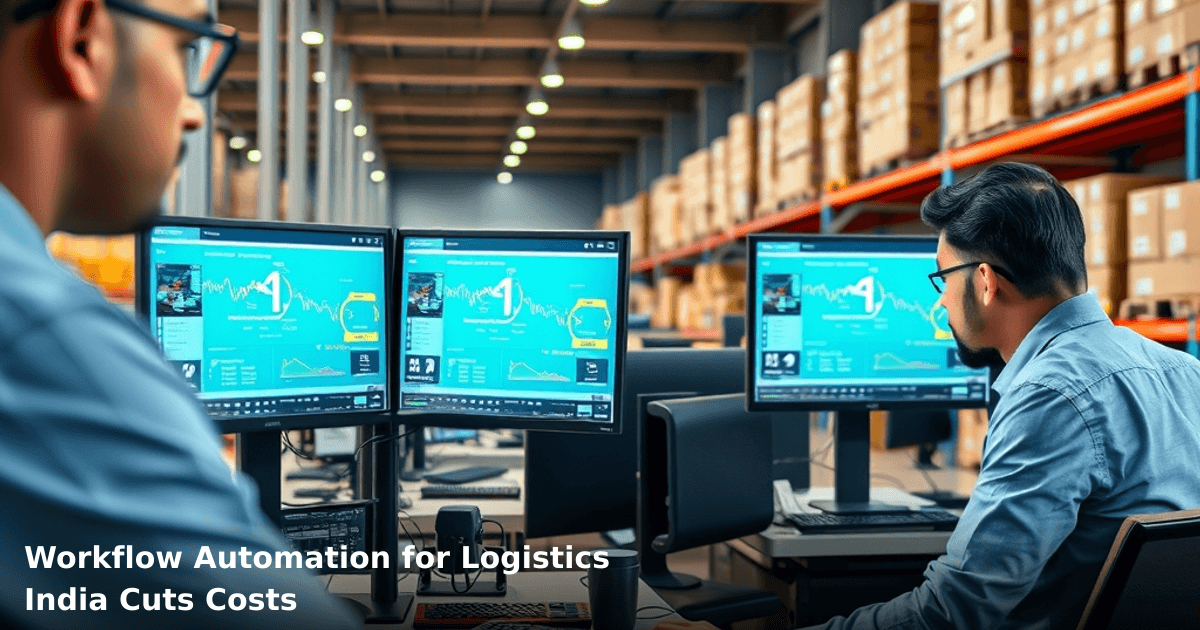
Workflow automation builds dashboards that update in real-time. Your operations manager logs in and sees today's metrics instantly. Your finance team gets a daily report emailed automatically at 8 AM. Your CEO sees KPIs without asking.
We built a custom analytics dashboard for a Delhi-based 3PL that saved their team 90 minutes daily in report generation. That's ₹6,500/month.
Comparison: Before and After Workflow Automation for Logistics
We build this automation for your business
Our team maps your current workflow, identifies automation opportunities, and delivers a working system in 2–3 weeks.
| Metric | Before Automation | After Automation | Savings |
|---|---|---|---|
| Order-to-TMS time | 15–20 mins (manual entry) | 2–3 mins (auto-sync) | 12–18 mins/order |
| Invoice generation | 1 person, 6–8 hours/day | 30 mins/day (exceptions only) | ₹10,000–₹15,000/month |
| Customer support calls | 40–50 "where's my shipment?" calls/day | 15–20 calls/day (customers have WhatsApp updates) | ₹6,000–₹8,000/month |
| Driver assignment time | 30 mins/day (manual) | 2–3 mins/day (auto-routed) | ₹8,000–₹12,000/month |
| Late deliveries | 8–12% of shipments | 3–5% of shipments | ₹5,000–₹10,000/month (fewer refunds) |
| Inventory reconciliation | End-of-day (12+ hrs lag) | Real-time | ₹4,000–₹8,000/month (fewer wrong shipments) |
| Report generation | 2–3 hours/day manual | 15 mins/day auto-generated | ₹4,000–₹6,000/month |
| Total Monthly Savings | — | — | ₹49,000–₹79,000/month |
Step-by-Step Guide: Implementing Workflow Automation for Logistics India
Step 1: Audit Your Current Processes (Week 1)
Map out exactly what happens from the moment an order arrives to when it's delivered and billed. Write down:
- Which systems are involved (TMS, warehouse software, billing, customer portal)?
- Where does data get entered manually?
- Where do delays happen?
- Which tasks take the most time?
For a typical 3PL, this is usually: order entry → warehouse picking → driver assignment → delivery → invoice → reconciliation.
Step 2: Identify Quick Wins (Week 1–2)
Not everything needs to be automated at once. Pick 2–3 processes that:
- Take the most time
- Have the most manual steps
- Cause the most customer complaints
For most logistics businesses, that's order entry and customer notifications. Start there.
Step 3: Check Your System Compatibility (Week 2)
Do your existing systems have APIs? Can they export/import data? Can they send webhooks (notifications when something happens)?
Most modern platforms do. If you're using Tally, SAP, or a cloud TMS, you're good. If you're on a very old legacy system, you might need a data bridge (usually ₹8,000–₹20,000 one-time setup).
Our AI & Automation service can audit this for you — we typically spend 2–3 hours reviewing your stack and identifying what can be connected.
Step 4: Build Your Automation Workflows (Week 3–4)
This is where the magic happens. You're building rules like:
- "When an order arrives via email, automatically create it in TMS and send a WhatsApp notification to the warehouse"
- "When a shipment is marked delivered, auto-generate an invoice and email it to the customer"
- "When a shipment is 30 minutes late, alert the operations team"
Most platforms (like Zapier, Make, or custom APIs) let you build these without coding. If your team isn't technical, a consultant can set these up in 2–3 days.
Step 5: Test with a Small Batch (Week 4)
Before going live with all 500 orders daily, test with 50 orders. Run them through your automated workflows. Check:
- Are all fields mapping correctly?
- Are notifications reaching the right people?
- Is data accurate in all systems?
- Are there any edge cases breaking the automation?
Fix issues here. It's cheaper than fixing them in production.
Step 6: Go Live and Monitor (Week 5+)
Roll out to 100% of orders. For the first 2 weeks, your team monitors closely. Are there unexpected errors? Are customers getting notified correctly? Is the data clean?
Most businesses see 95%+ success rate on first go. The remaining 5% are edge cases that need manual handling.
Step 7: Optimize Based on Data (Month 2+)
Now you have real numbers. Which processes saved the most time? Where are bottlenecks still happening? Automate the next layer.
Common Mistakes to Avoid
Mistake 1: Automating Bad Processes
Don't automate a broken workflow. If your current order entry process is chaotic, automating it just makes chaos faster. Fix the process first, then automate.
Mistake 2: Trying to Automate Everything at Once
You don't need 10 automations on day one. Start with 2–3 high-impact workflows. Once your team is comfortable, add more. This reduces risk and keeps costs down.
Mistake 3: Not Planning for Exceptions
95% of orders will flow smoothly through automation. The other 5% — wrong addresses, special requests, damaged goods — still need human judgment. Build a queue for exceptions, not a brick wall.
Mistake 4: Ignoring Data Quality
If your TMS has garbage data (wrong addresses, missing phone numbers), automation will propagate that garbage. Clean your data before automating.
Mistake 5: Not Training Your Team
Your team needs to understand what the automation does and how to handle exceptions. A 2-hour training session prevents weeks of confusion.
Key Takeaways
- Workflow automation for logistics India reduces manual labour by 60–80%, freeing your team for strategic work instead of data entry.
- Most businesses save ₹40,000–₹1,20,000 per month through reduced labour, fewer errors, and optimised operations.
- ROI typically hits within 90 days — setup costs (₹50,000–₹1,50,000) are recovered through monthly savings.
- Start small with 2–3 high-impact workflows (order entry, invoicing, customer notifications) rather than trying to automate everything at once.
- Real-time customer notifications via WhatsApp reduce support calls by 30–45% while improving customer satisfaction.
- Automated exception alerts catch problems before they become expensive — late deliveries, wrong shipments, inventory mismatches.
- You don't need to replace your existing systems — workflow automation bridges them together using APIs and webhooks.
Frequently Asked Questions
Quick answers about workflow automation for logistics india
01 How much will workflow automation actually cost my small logistics business? ›
Most Indian logistics SMBs spend ₹2-5 lakhs upfront for a basic automation setup (software licenses + implementation), then ₹15,000-30,000 monthly for maintenance and updates. You'll recover this within 8-12 months through reduced manual errors (typically 35-40% fewer mistakes), eliminated double-entry work, and faster delivery cycles—we've seen clients cut operational costs by ₹50,000-1 lakh per month once fully implemented.
02 How long does it actually take to set up automation in my logistics operations? ›
A phased rollout takes 6-8 weeks for order-to-delivery workflows, but you'll see results within 2-3 weeks once the first module (like automated order capture or route optimization) goes live. Most SMBs we work with start seeing 20-25% faster order processing within the first month, even before full system integration—the key is starting with your highest-pain workflow first, not trying to automate everything at once.
03 Is workflow automation only for big logistics companies, or can my 15-truck operation benefit? ›
Automation is perfect for your size—in fact, mid-sized operations like yours see the highest ROI because you're large enough to justify the investment but small enough to implement quickly without complex legacy systems. A 15-truck operation handling 200-300 shipments daily can cut dispatch time from 3 hours to 45 minutes using route automation alone, which translates to one extra delivery round per day.
04 We've heard automation means we'll lose jobs—is that actually true for logistics? ›
This is the biggest misconception—automation eliminates repetitive data entry and paperwork, not jobs; it shifts your team to higher-value work like customer problem-solving, quality checks, and route optimization. In our experience, logistics teams actually grow by 10-15% after automation because companies expand delivery capacity instead of cutting headcount, and your existing staff becomes more productive (one person managing what previously took 1.5 people).
05 How do we even start if we're using spreadsheets and phone calls right now? ›
Start by mapping your current process for one workflow (like order booking to pickup confirmation) for one week—you'll likely find 15-20 hours of manual work that automation can handle immediately. Pick a vendor offering a 30-day pilot (most charge ₹5,000-10,000 for this), test it on 20% of your daily orders, and if you see 30%+ time savings, you've got your business case to expand—this entire evaluation takes 4-6 weeks, not months.
Need this built for your business?
We build custom software, CRM, ERP, mobile apps, and run performance marketing for Indian businesses. Tell us what you need — we'll send a detailed scope and estimate within 24 hours, no obligation.
- Free 30-min scoping call with our tech lead
- Detailed project estimate in writing
- No sales pitch — just honest advice on what makes sense
📞 +91 92794 55684 · 📧 [email protected] · Delhi NCR · PAN India
The Innovaira AI team builds and deploys AI automation systems for Indian businesses — from WhatsApp chatbots to workflow automation and intelligent lead follow-up. ISO 42001:2023 certified AI management.