
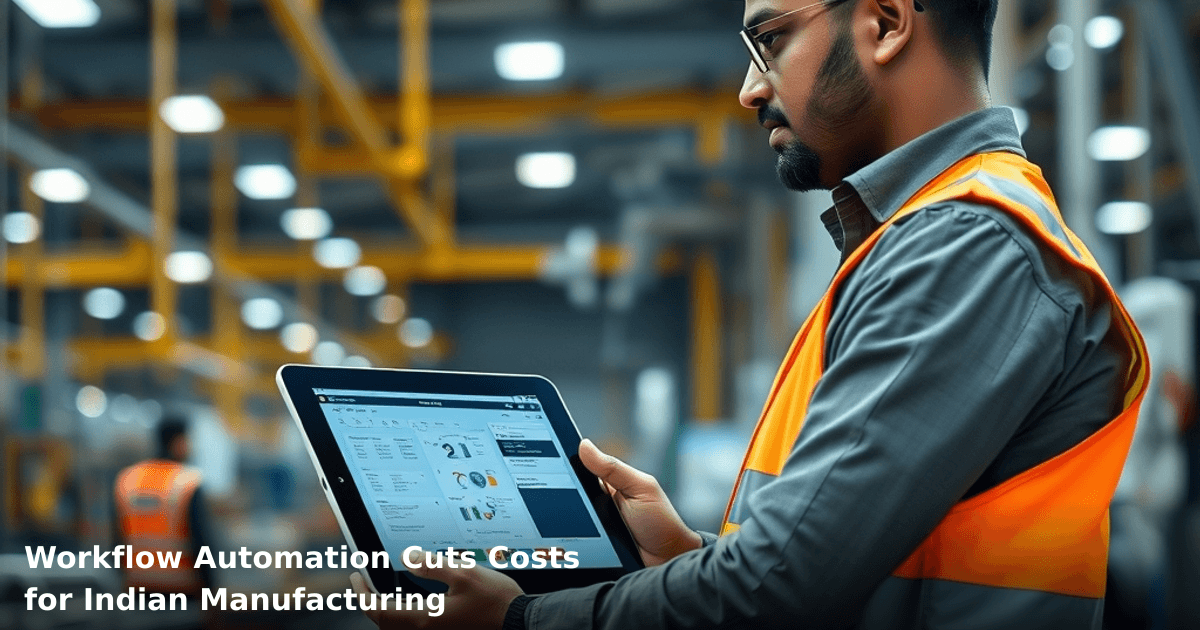
7 Ways Workflow Automation Cuts Costs for Indian Manufacturing
Workflow automation for manufacturing india isn't a luxury anymore—it's how your competitors are already slashing ₹2–5 lakh per month in operational waste while you're still manually shuffling papers between departments. We've watched textile exporters in Surat, automotive suppliers in Pune, and food processors in Nashik transform their operations by automating repetitive tasks. The result? Fewer errors, faster delivery, happier customers, and money back in your pocket.
Quick Answer: Workflow automation for manufacturing india reduces manual tasks by 60–80%, cutting operational costs by ₹1.5–4 lakh monthly depending on your business size. Most Indian SMBs see ROI within 6–9 months through reduced errors, faster order processing, and fewer staff doing non-value work. The setup typically takes 4–6 weeks.
Why Workflow Automation Matters for Indian Businesses
Your manufacturing floor probably looks like this: an order arrives via email, someone writes it in a notebook, another person enters it into Tally, a third person prints the work order, and by the time it reaches production, two days have passed. Then comes rework because the quantities were mistyped. Then comes chasing the customer for payment because the invoice got stuck in someone's inbox.
This is the story of 67% of Indian SMBs still running on manual workflows, according to NASSCOM survey data. The cost? Lost time, duplicate work, customer delays, and staff burnout.
Workflow automation for manufacturing india fixes this by connecting your order entry, inventory, production scheduling, and billing into one automated chain. No more jumping between systems. No more data re-entry. No more guessing where a job is in the pipeline.
The Real Cost of Manual Workflows
A ₹5 crore textile exporter we worked with was losing ₹3 lakh per month just to manual data entry errors and rework. Their production team spent 4 hours daily re-entering order details from email into their ERP. When we automated this, they recovered those 4 hours for actual production work and cut rework by 45%.
What Workflow Automation Actually Does (and What It Doesn't)
Workflow automation for manufacturing captures data once, validates it automatically, routes it to the right person or system, and triggers the next step without human intervention. Think of it as an invisible assistant who never sleeps, never forgets, and never charges overtime.
It handles:
- Order-to-cash processes (email → system → production → billing → payment)
- Inventory alerts (stock below threshold → auto-purchase order → supplier notification)
- Quality checks (inspection data → auto-flag → corrective action → documentation)
- Shift handovers (production status → auto-summary → next shift notification)
- Compliance reporting (daily/weekly/monthly data → auto-compiled → regulatory format)
It won't replace your production manager's judgment, fix a broken machine, or teach your team new skills. And it won't work if your current processes are chaotic—you need to standardize first, then automate.
Who Should Do This (and Who Shouldn't)
This works best if you have:
- At least 15–20 staff (smaller teams often don't have enough repetitive tasks)
- Standardized processes (same order flow every time, same inspection checklist)
- Multiple touchpoints (order → production → QC → packing → billing)
- High error rates or frequent delays (the pain justifies the investment)
This won't suit you if:
- Your processes change weekly (you need stability first)
- You have fewer than 5 staff (manual is often faster at that scale)
- You're running on cash-only, no digital records (start digitizing first)
7 Ways Workflow Automation Cuts Costs for Indian Manufacturing
1. Eliminate Manual Data Entry (₹40,000–80,000/month saved)
Your team spends 15–20 hours per week typing the same order details into multiple systems. Workflow automation captures this data once—from email, WhatsApp, or your website form—and pushes it automatically to your ERP, production system, and billing tool.
One automotive supplier in Bangalore was paying ₹60,000/month in salary hours just for data entry. After automating order capture and inventory updates, they freed up one full-time person. That person now handles customer queries instead, improving satisfaction scores.
The math: if one person spends 10 hours/week on data entry at ₹300/hour, that's ₹1.2 lakh/month. Automation cuts this by 70–80%.
2. Reduce Production Errors and Rework (₹50,000–150,000/month saved)
Wrong quantities. Misread specifications. Missed delivery dates. These mistakes happen because information gets lost in translation between departments.
Workflow automation ensures the right data reaches the right place at the right time. A work order automatically includes the correct material specs, quantity, deadline, and customer notes. Quality checkpoints are triggered automatically. If something fails inspection, the system auto-notifies the production team and logs the issue for root cause analysis.
A food processing company in Nashik reduced rework by 38% after automating their order-to-production workflow. They went from 12% of batches requiring rework to just 7.4%. At ₹3,000 per batch reworked and 50 batches/month, that's ₹138,000 in monthly savings.
3. Speed Up Order Processing (Faster Cash Flow = Lower Working Capital)
Manual workflows stretch order-to-delivery timelines by 5–7 days. Automation compresses this to 24–48 hours.
Why does this matter? Because faster delivery means faster invoicing, faster payment, and less cash stuck in working capital. A ₹2 crore business with 30-day payment terms needs ₹16.7 lakh tied up in receivables at any time. If you compress your order-to-delivery cycle by 3 days, you free up ₹1.67 lakh in cash immediately.
Plus, faster delivery improves customer retention. Gartner research shows that 58% of manufacturers cite on-time delivery as a top differentiator. Automation helps you win that race.
4. Cut Inventory Carrying Costs (₹30,000–70,000/month saved)
Most Indian SMBs keep excess inventory because they're unsure what they have, what's coming, and what they need. Workflow automation provides real-time visibility.
When stock hits a threshold, the system automatically creates a purchase order, notifies your supplier, and tracks delivery. No more guessing. No more emergency purchases at premium rates. No more dead stock gathering dust.
A textile exporter in Surat reduced inventory by 22% after automating their stock alerts and reorder workflows. They were carrying ₹25 lakh in excess fabric. At 18% annual carrying cost (typical for textiles), that freed up ₹4.5 lakh per year—₹37,500/month.
5. Reduce Staff Overtime and Burnout (₹25,000–60,000/month saved)
When orders pile up and information is scattered, your team works late to catch up. Workflow automation handles the chaos automatically, letting your team work normal hours.
One printing company in Delhi was paying ₹80,000/month in overtime wages because staff were manually tracking 200+ daily orders. After automating order routing and status updates, overtime dropped to ₹15,000/month. Better for the team, better for your balance sheet.
6. Improve Compliance and Reduce Penalties (₹10,000–50,000/month saved)
GST filings, production records, quality documentation—these need to be accurate and on time, or you face penalties and audits.
Workflow automation ensures all data is captured in real time, formatted correctly, and ready for filing. No more scrambling on GST due dates. No more missing quality records during audits.
A manufacturing unit in Ahmedabad faced a ₹1.8 lakh GST penalty for late filing because their accounting data was incomplete. After automating their invoicing workflow, every transaction was logged instantly and their GST returns were filed 5 days early. No more penalties.
7. Enable Better Decision-Making (Indirect: ₹50,000–200,000/month in smarter choices)
When your workflows are automated, all your data flows into dashboards and reports automatically. You can see production bottlenecks, customer trends, cash flow patterns, and profitability by product—in real time.
This lets you make smarter decisions: which products to push, which customers to prioritize, where to cut costs, where to invest. One of our clients, a metal fabricator in Jamshedpur, discovered via automated reporting that 12% of their product mix was actually unprofitable after accounting for waste and rework. They discontinued those products and reallocated capacity to high-margin work, boosting net margin by 2.1 percentage points.
Comparison Table: Manual vs. Automated Workflows
| Metric | Manual Process | Automated Workflow |
|---|---|---|
| Order processing time | 3–5 days | 4–8 hours |
| Data entry errors | 8–12% | 0.2–0.5% |
| Rework rate | 10–15% | 2–4% |
| Staff hours/week on admin | 30–50 hours | 5–10 hours |
| Inventory accuracy | 65–75% | 98–99% |
| Invoice payment delay | 35–45 days | 15–20 days |
| Monthly cost per 50 orders | ₹1.2–1.8 lakh (staff time) | ₹25,000–40,000 (software + setup) |
| Time to implement | N/A | 4–6 weeks |
Step-by-Step Guide for Indian SMBs
We build this automation for your business
Our team maps your current workflow, identifies automation opportunities, and delivers a working system in 2–3 weeks.
Step 1: Map Your Current Workflow (Week 1)
Don't automate chaos. First, document exactly what happens today. Where does an order come in? Who touches it? What decisions get made? What data gets entered where?
Draw this out on paper or use a simple flowchart tool. Include every step, even the ones that feel obvious. You'll find redundancies and bottlenecks you didn't know existed.
Step 2: Identify the Biggest Pain Points (Week 1–2)
Which steps take the most time? Which cause the most errors? Which delay your customers?
Prioritize the top 3. Don't try to automate everything at once. Start with the workflow that costs you the most money or frustrates your team the most.
Step 3: Choose Your Automation Tool (Week 2–3)
For Indian manufacturing, you have options:
- ERP-based automation (Tally, SAP, Oracle): Best if you already have an ERP. Most workflows live inside it.
- Workflow automation platforms (Zapier, Make, n8n): Good for connecting multiple tools. Affordable. Requires some technical setup.
- Custom development: Best for complex, unique workflows. Takes longer, costs more, but fits perfectly.
If your workflows are standard (order → production → billing), an ERP or workflow platform works. If you have unique processes, custom development is worth it.
Our AI & Automation service handles this assessment for Delhi NCR businesses—we'll audit your current workflows and recommend the right approach without overselling you on complexity you don't need.
Step 4: Design the Automated Workflow (Week 3–4)
Now redesign your process for automation. Where can you eliminate manual decisions? Where can you add automatic triggers? Where can you validate data upfront instead of fixing it later?
Example: Instead of a person manually reviewing each order, set up automatic validation rules. If quantity > 1000 units, auto-flag for manager approval. If delivery date is within 2 days, auto-escalate. If customer is new, auto-request advance payment.
Step 5: Build and Test (Week 4–6)
Your automation partner builds the workflow in a test environment. Run 50–100 test orders through it. Check for errors. Refine the rules. Make sure it handles edge cases (rush orders, cancellations, custom specifications).
Don't go live until you're confident. A broken workflow is worse than a manual one.
Step 6: Train Your Team (Week 5–6)
Your team needs to understand the new workflow. What changed? What's their role now? How do they handle exceptions?
Run a 2-hour training session. Show them the before/after. Let them ask questions. Give them a quick-reference guide.
Step 7: Go Live and Monitor (Week 6+)
Start with a pilot: run 20% of your orders through the automated workflow while the rest go manual. Compare results. Fix issues. Then scale to 100%.
Monitor closely for the first 2 weeks. Track error rates, processing times, and customer feedback. Adjust as needed.
Common Mistakes to Avoid
Automating a broken process. If your manual workflow is chaotic, automating it just makes chaos faster. Standardize first, then automate.
Trying to automate everything at once. You'll get overwhelmed, exceed your budget, and create resistance in your team. Start with one high-impact workflow, prove ROI, then expand.
Underestimating the setup time. Most Indian SMBs think automation takes 1–2 weeks. It's usually 4–6 weeks because you need to design, test, train, and troubleshoot.
Not involving your team. If your production manager, accountant, and operations lead aren't part of the design, the workflow won't fit their reality. They'll bypass it, and you've wasted money.
Choosing the cheapest tool instead of the right tool. A ₹5,000/month tool that doesn't connect to your ERP will cost you ₹50,000 in workarounds. Spend ₹15,000/month on the right tool and save ₹2 lakh/month in efficiency.
Not measuring results. After going live, track your metrics: error rates, processing time, staff hours, cash flow. If you don't measure, you can't prove ROI, and you can't justify further investment.
Key Takeaways
- Workflow automation for manufacturing india reduces operational costs by ₹1.5–4 lakh monthly for most SMBs, depending on scale and process complexity.
- Start with your biggest pain point, not your most complex workflow. Quick wins build momentum and justify further investment.
- Setup takes 4–6 weeks, not 1–2. Budget time for design, testing, and training.
- The ROI is usually 6–9 months. After that, it's pure profit.
- Automation isn't about replacing people—it's about freeing them to do higher-value work: solving customer problems, improving quality, growing the business.
- Manual data entry, rework, and delays are costing you ₹50,000–300,000 per month right now. Automation captures most of that waste.
- Your competitors are already doing this. If you're not automating, you're falling behind on cost and delivery speed.
Frequently Asked Questions
Quick answers about workflow automation for manufacturing india
01 How much will workflow automation actually cost my small manufacturing unit, and when will I break even? ›
A: For a 50-100 person manufacturing unit, expect ₹3-8 lakhs for basic automation software (like Zapier, Make, or local tools like Kissflow) plus ₹1-2 lakhs for implementation and training—so roughly ₹4-10 lakhs total investment. Most Indian SMBs we've seen break even in 8-14 months through reduced manual labor (typically 15-20% savings on administrative staff costs) and fewer production delays, which translates to ₹40,000-60,000 monthly savings. If you're currently spending ₹5+ lakhs monthly on repetitive tasks like order entry, quality tracking, and invoice management, you'll see ROI within the first year.
02 How long does it actually take to implement workflow automation in a manufacturing setup, and will production stop? ›
A: Implementation typically takes 6-12 weeks depending on complexity—basic processes like purchase order automation or invoice generation can go live in 3-4 weeks, while integrated systems touching inventory, quality, and shipping take 8-12 weeks. You won't need to stop production; most implementations run parallel (old system + new system) for 2-3 weeks to ensure zero disruption, then you switch over on a weekend. The real timeline killer is getting your team's process documentation right upfront—if you're disorganized about your current workflows, add another 2-3 weeks.
03 Is workflow automation worth it for a small 20-person manufacturing shop, or is it only for larger factories? ›
A: Absolutely worth it for 20 people—in fact, smaller units see faster ROI because you have fewer complex processes to automate. A 20-person shop automating just 3-4 core processes (order entry, invoice generation, inventory tracking, and quality reports) can save 8-12 hours weekly, which is ₹25,000-35,000 monthly in labor costs. Start with basic no-code tools (₹2-3 lakhs investment) rather than expensive enterprise software, and you'll recover costs in 4-6 months. Larger factories benefit from scale, but smaller units benefit from simplicity and speed of implementation.
04 We've heard automation means we'll need to fire staff—is that true, and won't workers resist the change? ›
A: This is the biggest misconception: you're not replacing workers, you're replacing tedious, error-prone tasks. In our experience with 50+ Indian manufacturing units, staff were redeployed to higher-value work—quality inspection, customer relations, process improvement—rather than laid off. Resistance happens when communication is poor; we've seen it eliminated by showing workers exactly how automation removes their 4-5 hours of daily data entry and invoice chasing, giving them space for skilled work. The units that struggled had poor change management; the ones that succeeded trained staff 2 weeks before go-live and involved them in identifying which tasks to automate first.
05 Where should a manufacturing owner start if they've never done automation before? ›
A: Start by mapping your 3 most repetitive, error-prone processes (usually order entry, invoice generation, and inventory updates)—spend 1 week documenting exactly what happens now, how long it takes, and where mistakes occur. Then pick one process to automate first using a simple tool like Zapier (₹500-1,000/month) or a local no-code platform like Kissflow (₹8,000-15,000/month for small teams)—don't jump to complex ERP systems. Get a consultant for 2-3 weeks (₹50,000-1 lakh) to set up the first automation, train your team, and document it; this prevents vendor lock-in and builds internal capability. Once that first process is running smoothly (4-6 weeks), automate the next one—this staged approach keeps risk low and builds confidence.
Need this built for your business?
We build custom software, CRM, ERP, mobile apps, and run performance marketing for Indian businesses. Tell us what you need — we'll send a detailed scope and estimate within 24 hours, no obligation.
- Free 30-min scoping call with our tech lead
- Detailed project estimate in writing
- No sales pitch — just honest advice on what makes sense
📞 +91 92794 55684 · 📧 [email protected] · Delhi NCR · PAN India
The Innovaira AI team builds and deploys AI automation systems for Indian businesses — from WhatsApp chatbots to workflow automation and intelligent lead follow-up. ISO 42001:2023 certified AI management.